On this page
- What "Milgauss" Actually Means
- The Origin Story
- The Comeback, and the Quirks That Made It Famous
- The Quiet Exit
- What a Milgauss Costs Now
- Why the Cult Exists
- Buying One Today
- FAQ
- What does Milgauss mean?
- Is the Rolex Milgauss discontinued?
- What is special about the green crystal?
- How does the Milgauss resist magnetism?
- How much does a Milgauss cost now?
- Is the Milgauss a good investment?
- Conclusion
Most Rolex models are defined by what they do for you at the beach, the summit or the airport. The Milgauss was defined by what it did for you near a particle accelerator. It was never going to be the brand's best seller, and Rolex quietly retired it in 2023 with no replacement and no farewell. The cult around it has only grown since.
What "Milgauss" Actually Means
The name is French and literal: mille for a thousand, gauss for the unit of magnetic flux density. It tells you the promise on the box, which was that the watch would keep running accurately in magnetic fields up to 1,000 gauss.
That mattered because magnetism is the quiet enemy of a mechanical watch. Reports put the trouble point for an ordinary movement at somewhere between 50 and 100 gauss, a level you can reach near the wrong piece of lab or hospital equipment. A magnetized hairspring makes a watch run fast, then erratically.
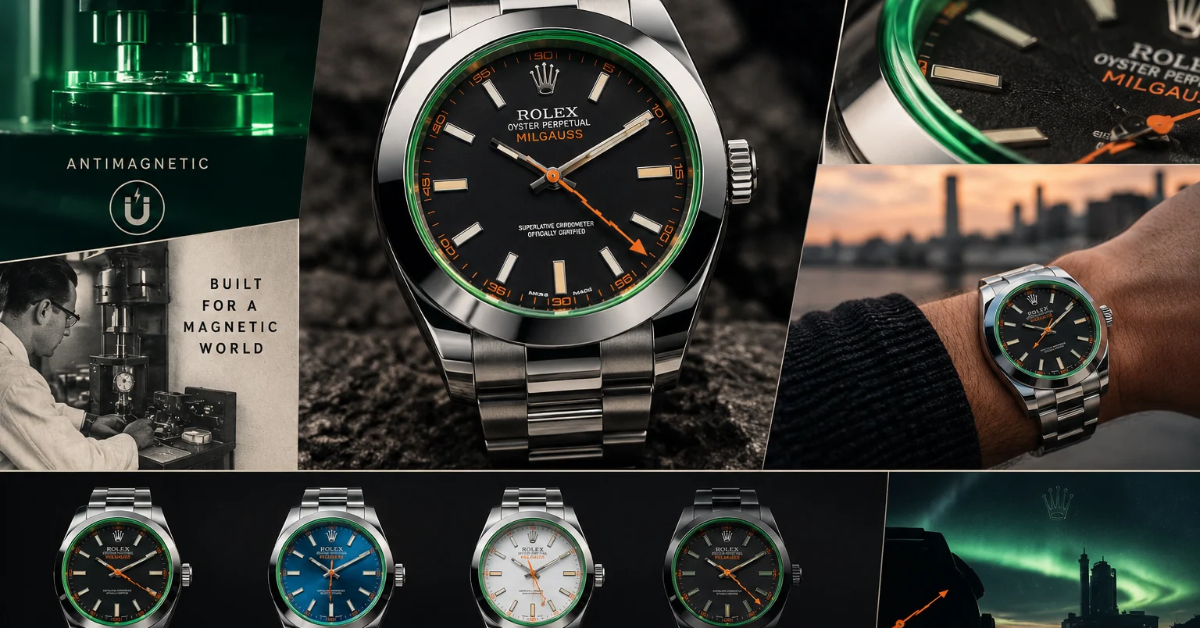
Rolex's answer was a shield. A soft-iron Faraday cage wrapped around the movement diverts magnetic fields away from the parts that keep time, and an iron plate protects the dial side. It's the same principle used to shield sensitive electronics, scaled down to fit inside a 40mm case.
The Origin Story
Collector histories trace the Milgauss to the mid-1950s and a prototype, reference 6543, of which only about 150 are believed to have been made. The account that has stuck is that scientists at CERN tested the first run and found it held up to 1,000 gauss. Details of exactly how the watch came about vary from one telling to the next, but the CERN testing of that early batch turns up consistently in the standard guides.
The first production Milgauss, reference 6541, arrived in 1956 with the feature that would define it: a seconds hand shaped like a bolt of lightning. It was a wink at the scientific crowd the watch was built for, and it's still the first thing people mention when they describe one.
The original run ended in the late 1980s. The Milgauss then spent about two decades off the catalog.
The Comeback, and the Quirks That Made It Famous
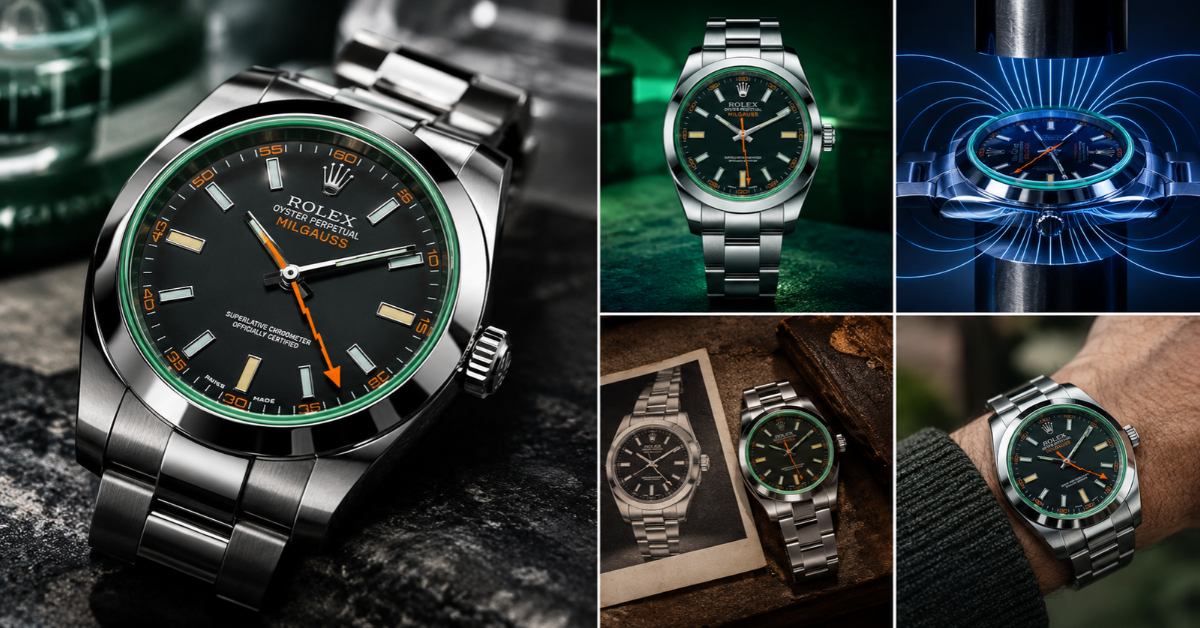
Rolex revived the name in 2007 with the 116400 and a variant that went further than anyone expected: the 116400GV, with a green-tinted sapphire crystal. Rolex never put that crystal on any other model, and it gives the dial an aquarium glow that photographs strangely and looks different in every light.
The details kept stacking up:
- The orange lightning bolt hand. The old wink returned in bright orange against the dial.
- The Z-Blue dial. Added in 2014, a saturated blue that pairs with the green crystal, and the combination collectors now rank at the top of the modern range.
- A 40mm Oystersteel case. Our guide to Oystersteel explains why Rolex's 904L steel is the same grade used across the sports line.
By 2016 the plain-crystal variants were gone, leaving only the two green-crystal 116400GV models: a black dial and the Z-Blue.
The Quiet Exit
At Watches & Wonders 2023, the Milgauss simply wasn't in the catalog anymore. Rolex gave no reason and announced no successor. The last retail price for the 116400GV was around $9,300.
The explanations on offer are guesses. The most common is that anti-magnetic protection has become less of a selling point as modern hairsprings in silicon and special alloys resist magnetism on their own. That's plausible, but Rolex hasn't said so. Our Perpetual Calibre explainer covers the Parachrom hairspring and the antimagnetic work in Rolex's current movements, which makes the theory easier to follow.It wasn't alone in leaving that year. The Cellini also went in 2023, though that collection was replaced by the 1908, as we cover in our Cellini retrospective. The Milgauss got no such handover, which is part of why its absence is so noticeable.
What a Milgauss Costs Now
With no new supply, prices depend on which version you want. Recent pre-owned ranges, which vary a little between sources:
- 116400 (clear crystal): roughly $8,500 to $11,000
- 116400GV, black dial, green crystal: roughly $9,000 to $12,000
- 116400GV, Z-Blue dial, green crystal: roughly $9,500 to $15,000
- Vintage 6541: a different universe entirely. One example reportedly sold at auction in 2023 for $2.5 million, though the source behind that figure noted speculation that Rolex itself bought the watch, which would make it a poor guide to the wider market.
Some trackers say prices are up 20% to 30% since production ended, particularly on the Z-Blue. That's one dataset, and a young price run is a poor basis for confidence. Our look at how Rolex prices have changed over the decades is a useful reminder that the strongest long-run gains came from steady demand, not from a few good years after a model's discontinuation. The same caution applies to the Pepsi bezel, which we cover in our GMT-Master II verdict.
Why the Cult Exists
A cult needs a reason to be a cult, and the Milgauss has several:
- It breaks the Rolex pattern. Most of the catalog follows a recognizable formula. The Milgauss has a lightning bolt, a tinted crystal and a dial color found nowhere else.
- It has a story. Built for scientists and rumored to have been tested at CERN is a better origin than most luxury watches can claim.
- It was easy to get and then it wasn't. For years you could walk into a dealer and buy one, so it never carried the hype of a waitlisted sports watch. The 2023 discontinuation changed that. See our waiting list guide for how different that was from the experience of trying to buy a Submariner.
- It's finite. Nobody is making more.
None of that makes it a sure thing for investors. It makes it a satisfying watch for someone who wants a Rolex nobody else on the train is wearing.
Buying One Today
Because every Milgauss is now pre-owned, condition and originality matter more than usual:
- Check the crystal. On a 116400GV, make sure the green crystal hasn't been swapped for a clear one. A replaced crystal cuts the value significantly.
- Check the dial and hands. The orange lightning bolt seconds hand and the original dial should be present and correct.
- Know the reference. Our reference numbers decoded guide helps you confirm a 116400 or 116400GV is what the listing claims.
- Authenticate before you pay. Our field guide to spotting a fake Rolex and 7 signs a Rolex might be a fake cover the checks that apply to any pre-owned Rolex, and a discontinued model with rising prices is exactly what counterfeiters like.
- Budget for service. A complete overhaul on a model like this typically falls in the lower tier of Rolex service pricing, covered in our servicing costs guide.
FAQ
What does Milgauss mean?
It combines the French mille, for one thousand, with gauss, the unit of magnetic induction, referring to its resistance to fields up to 1,000 gauss.
Is the Rolex Milgauss discontinued?
Yes. Rolex discontinued the Milgauss in 2023 and has not announced a replacement, so all examples are now sold pre-owned.
What is special about the green crystal?
The 116400GV uses a green-tinted sapphire crystal that Rolex never offered on any other model, which gives the dial its distinctive tint.
How does the Milgauss resist magnetism?
A soft-iron Faraday cage around the movement diverts magnetic fields away from the parts that keep time, with an iron shield on the dial side.
How much does a Milgauss cost now?
Modern 116400 references generally range from about $8,000 to $15,000 pre-owned, depending on dial, crystal and condition. Vintage examples cost far more.
Is the Milgauss a good investment?
Prices have firmed since discontinuation according to some trackers, but a short run is no guarantee. It's best bought because you want to wear it.
Conclusion
The Milgauss never fit neatly into Rolex's catalog, and that is precisely why people still talk about it. It's a tool watch for a job almost nobody has, with a lightning bolt on the dial and a green tint over the whole thing. Rolex's decision to drop it without a word only made the case for owning one stronger.
Senior Writer
James Whitfield
Senior watch writer with a decade covering Swiss horology, vintage markets and modern releases.