On this page
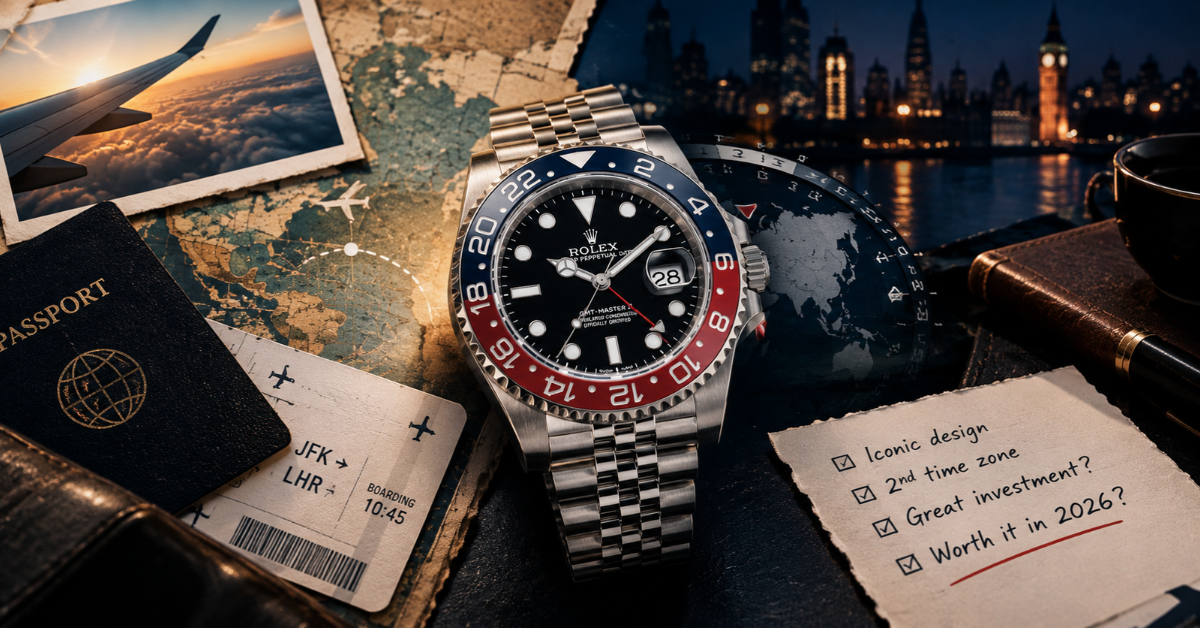
The Rolex GMT-Master II is worth it in 2026 if you will use its second time zone and can buy it near retail, which runs roughly $11,000 to $12,300 in steel. It tracks up to three time zones through an independently adjustable hour hand, a 24-hour hand, and a rotating bezel, and it runs the Caliber 3285 with a 70-hour power reserve. The big change this year is that Rolex discontinued the red-and-blue Pepsi at Watches & Wonders in April 2026, which pushed its resale price to $22,000 or more and left the Batman as the most available steel model. Paying secondary-market premiums for any colorway is harder to justify.
Most GMT-Master II advice was written before April 2026, and it now points people in the wrong direction. The watch itself hasn't changed much. The lineup, the resale market, and the argument for buying one have.
What You're Actually Buying
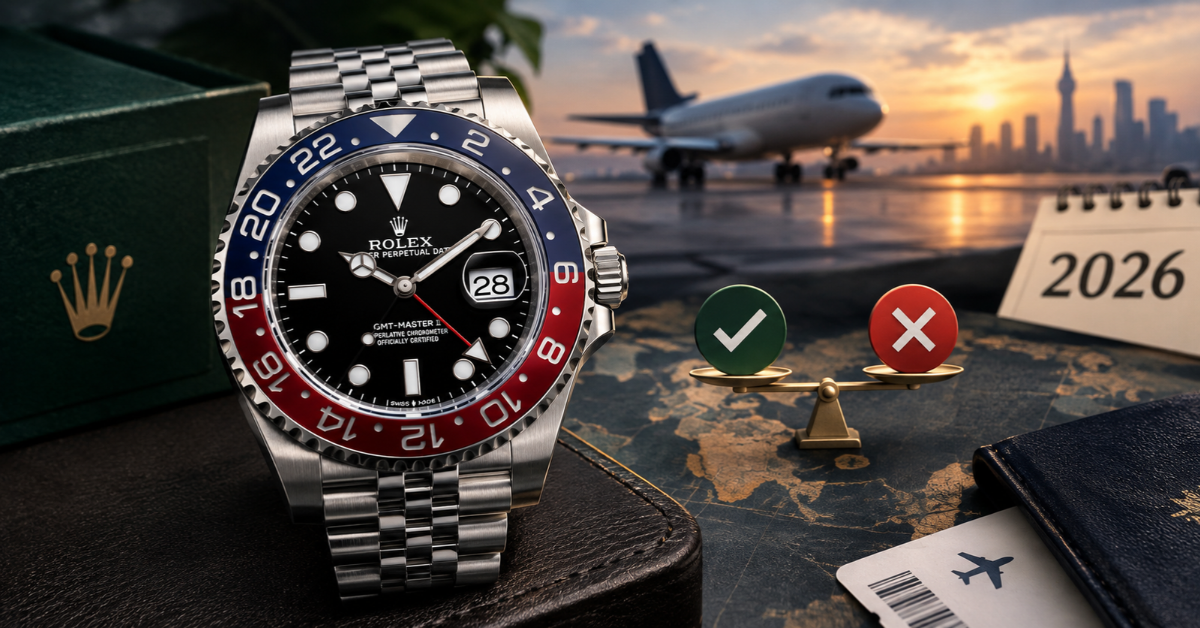
The GMT-Master II is a 40mm Oystersteel sports watch with a two-tone ceramic bezel that rotates and carries 24-hour markings. Inside is Caliber 3285, which gives you a 70-hour power reserve and Rolex's Superlative Chronometer certification. What sets it apart from an ordinary date watch is the way the extra hand works. The local hour hand can be moved forward or back in one-hour jumps without stopping the watch or disturbing the minutes, the 24-hour hand keeps your home time, and the rotating bezel lets you read a third zone. Our guide to setting a Rolex date walks through exactly how the crown behaves on this model.
That capability was built for airline crews in 1954, and it still solves the same problem. If you never cross time zones or call people in one, the feature does nothing for you.
The 2026 Twist: The Pepsi Is Gone
At Watches & Wonders in April 2026, Rolex removed the red-and-blue Pepsi from its catalog. That covers the steel 126710BLRO on both bracelets and the white gold 126719BLRO, including the meteorite and midnight blue lacquer dial variants. For the first time in the ceramic era, the steel catalog has no red bezel at all. Rolex gave no farewell and no replacement.
The reason hasn't been confirmed by Rolex. Trade specialists point to the difficulty of fusing two colors into one ceramic bezel, a process that involves sintering at temperatures reported between 850 and 1,300 degrees Celsius. One specialist quoted in the coverage was careful to call this trade talk, which is the right way to treat it. What's certain is the effect on prices.
The Lineup That's Left
The Batman, reference 126710BLNR with a blue and black bezel, is now the most available steel GMT-Master II in the current catalog. It has been offered on either a Jubilee or an Oyster bracelet since 2019, when it replaced the earlier 116710BLNR and moved from Caliber 3186 to the 3285. Two other steel options remain: the Bruce Wayne, reference 126710GRNR with a grey and black bezel, and the Sprite, reference 126720VTNR, a green and black model with the crown on the left. Gold references sit well above these. Our GMT-Master II bezel guide covers where each colorway came from and how the two-tone ceramic is made.
What It Costs: Retail Versus Reality
Steel models list at roughly $11,000 to $12,300 depending on reference, bracelet, and when the figure was published, since Rolex adjusted pricing during 2026. Solid gold versions run from about $38,000 into the high $50,000s.
Almost nobody pays list price. Recent secondary-market ranges for steel references look like this:
- Batman: about $15,000 to $20,000, with the Jubilee at the top of the range
- Sprite: about $16,000 to $20,000
- Bruce Wayne: about $19,000 to $23,000
- Pepsi: about $22,000 to $25,000 on average, with unworn 2026-dated examples reported at $40,000 and above
One market tracker showed a 2024 Pepsi trending near $32,900, close to three times its retail price. The gap between list and street is the real cost of ownership here. Steel GMT-Master II models sit behind long dealer waitlists, and our Rolex waiting list coverage explains why the wait is realistic for some references and not for others.
Should You Pay Up for a Pepsi?
Be careful with this one. Discontinued Rolex references often climb, and the aluminum-bezel 16710 that ended production in 2007 rose steadily afterward. That history is why buyers are bidding hard right now. But a price spike right after a discontinuation is partly speculation, and the watch market has a recent example of what happens when speculation runs ahead of demand. Our Submariner pricing guide covers how 2021 and 2022 premiums of 80% to 120% over retail later settled closer to 30% to 50%.
If you love the red and blue and would wear it daily, buying one is a personal call. If your main reason is that it will surely go up, the evidence doesn't support that level of confidence.
Ownership Costs
A complete service at a Rolex Service Center for this tier of movement generally runs about $800 to $950, and our servicing costs guide shows what that includes and how to budget for it. The 70-hour reserve means the watch survives a weekend in a drawer, though you'll need to reset the local hour hand if it stops.
Who It's Worth It For
Buy one if you travel across time zones or work with people who do, you value a rotating-bezel GMT specifically, and you can get a watch at or near list price through an authorized dealer.
Think twice if you only want the look. The extra complication adds cost and complexity you won't use. A simpler Rolex sports watch will serve you as well for less money.
Be wary if the only way to get one is a premium of $5,000 to $10,000 or more over list. The engineering is excellent, but the premium is paying for scarcity and speculation, not for a better watch.
Buying With Confidence
At these prices, verify what you're buying. Reference 126710BLNR should correspond to a real configuration, and our reference numbers decoded guide explains how to read that string. For the buying-process warning signs that show up before you ever inspect the watch, see 7 Signs Your Rolex Might Be a Fake.
FAQ
Is the Rolex GMT-Master II worth buying in 2026? Yes, if you'll use the second time zone and can buy near the roughly $11,000 to $12,300 steel list price. It's harder to justify at resale premiums of $5,000 or more.
Did Rolex discontinue the Pepsi GMT-Master II? Yes. Rolex removed the steel 126710BLRO and white gold 126719BLRO at Watches & Wonders in April 2026 with no replacement.
What is the most available steel GMT-Master II now? The Batman, reference 126710BLNR, is now the most available steel model in the current catalog.
How many time zones can the GMT-Master II track? Three, using the independently adjustable local hour hand, the 24-hour hand, and the rotating 24-hour bezel.
How much does the GMT-Master II cost on the secondary market? Steel references generally start around $15,000 for the Batman and reach $22,000 to $25,000 or more for the discontinued Pepsi.
Conclusion
The GMT-Master II is still one of the strongest sports watches Rolex makes, and its case rests on real function: a movement built for tracking time in more than one place. The 2026 Pepsi discontinuation made the market louder and the pricing harder to read. Decide whether you need the function, buy as close to list price as you can, and treat any resale premium as a cost rather than a guarantee.
Senior Writer
James Whitfield
Senior watch writer with a decade covering Swiss horology, vintage markets and modern releases.