
On this page
- Understanding the Crown Positions First
- The Rule That Applies Almost Everywhere: Avoid 9 PM to 3 AM
- Datejust and Lady-Datejust
- Day-Date (President)
- Submariner Date
- Submariner No-Date (124060)
- GMT-Master II: The One That Actually Works Differently
- Explorer II
- Oyster Perpetual
- Older, Non-Quickset References
- Why Getting This Right Matters
- FAQ
- Conclusion
On most quickset Rolex models — Datejust, Submariner Date, Day-Date — unscrew the crown, pull it to the middle position, and turn clockwise until the correct date appears, then pull to the final position to set the time. The Submariner no-date reference has no date function or quickset position at all. The GMT-Master II works differently: its first crown position independently jumps the local hour hand without disturbing the date, seconds, or 24-hour GMT hand. Across every quickset model, avoid adjusting the date between roughly 9 PM and 3 AM, when the internal date-change mechanism is already engaged and forcing it risks real damage.
Setting a Rolex date sounds like it should be identical across the whole catalog, and the basic mechanism is genuinely similar model to model — but the specifics differ enough, particularly on the GMT-Master II and the no-date Submariner, that following generic instructions can leave you confused or, in the worst case, risk damaging the date mechanism. This covers what actually changes model by model, plus the one timing rule that applies almost universally.
Understanding the Crown Positions First
Before the model-specific instructions, it's worth establishing the numbering convention this guide uses, since sources online aren't always consistent about how they count crown clicks. Here, Position 0 is fully screwed down against the case — the default, watertight position. Position 1 is the first click out, generally used for manual winding. Position 2 is the second click out, the quickset date position on models that have one. Position 3 is the final click, fully out, used to set the actual time — pulling to this position stops the seconds hand entirely, a feature called "hacking," which lets you synchronize the watch precisely against a time reference.
Always unscrew the crown counterclockwise first, before pulling to any position — attempting to pull a screwed-down crown risks damaging the winding stem.
The Rule That Applies Almost Everywhere: Avoid 9 PM to 3 AM
This is worth understanding before touching any specific model, because it applies broadly across Rolex's quickset watches. Roughly between 9 PM and 3 AM, the date-change mechanism inside the movement is already mechanically engaged, preparing for the date to advance at midnight. Forcing a quickset adjustment during that window can bend or damage the internal date-change components — a real risk, not an old wives' tale repeated without reason.
If you're unsure what time your watch's hands are actually pointing to relative to that window, a safe approach many watchmakers recommend is setting the time forward to a clearly safe hour — around 6 AM — before making any date adjustment, then setting the final correct time afterward. Damage from ignoring this rule is exactly the kind of repair that shows up in a service estimate; our Rolex servicing costs guide covers what that kind of unplanned repair can add to a routine service bill.
Datejust and Lady-Datejust
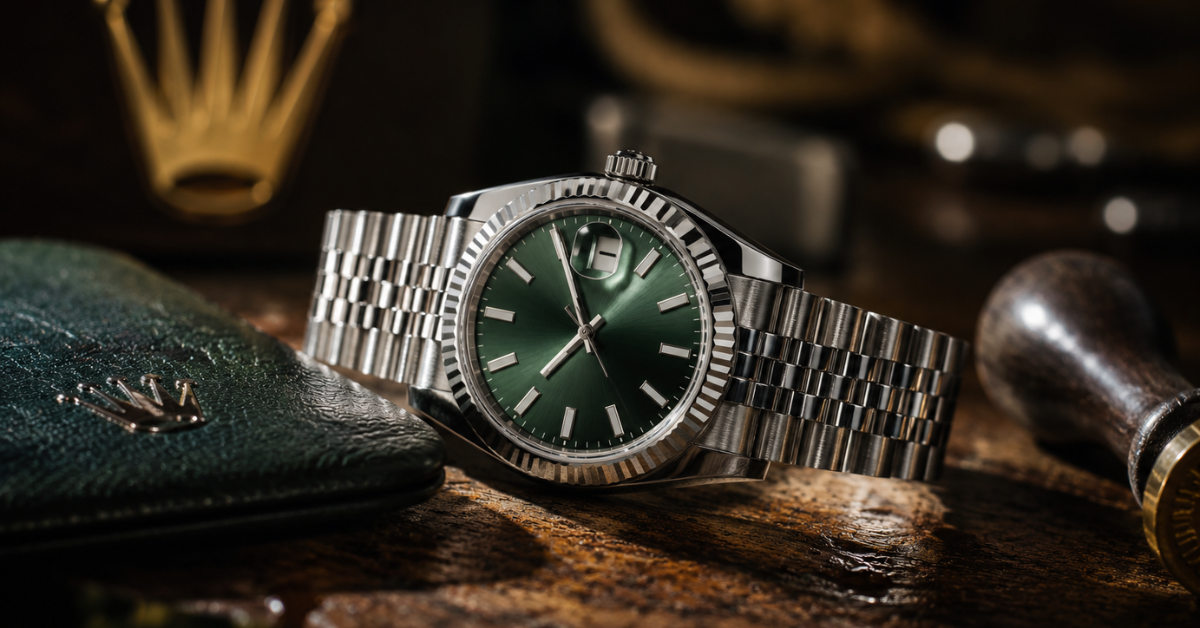
The Datejust uses a standard three-position quickset system. Unscrew the crown to Position 2 and turn clockwise until the correct date appears in the window — turning counterclockwise has no effect on the date on a standard Datejust. Once the date is correct, pull to Position 3 to set the exact time, using the hacking seconds hand to synchronize precisely. On current Caliber 3235 movements, the date changes instantaneously at midnight rather than gradually, so there's no need to account for a slow transition the way older movements required.
Day-Date (President)
The Day-Date works differently from the standard Datejust in one important way: Position 2 controls both the day and the date, not just the date. Turning the crown clockwise advances the date; turning it counterclockwise advances the day display. Set both before moving to Position 3 to finalize the time. On current Caliber 3255 movements, both the day and date change instantaneously at midnight together, matching the same precision found in the current Datejust caliber.
Submariner Date
The Submariner Date follows the same quickset pattern as the standard Datejust: Position 2 to quickset the date clockwise, Position 3 to set the time with hacking seconds. Every current Submariner Date reference includes this quickset function.
Submariner No-Date (124060)
Worth flagging specifically, since it trips people up: the no-date Submariner has no date complication at all, and therefore no quickset position. The crown moves directly from the winding position to the time-setting position — there's no middle "Position 2" step to worry about, because there's no date window to advance. If you're trying to quickset a date on this reference and can't find the function, that's expected; the watch simply doesn't have one.
GMT-Master II: The One That Actually Works Differently
This is the model most worth understanding carefully, because its Position 1 does something genuinely different from every watch covered above — and it's the entire reason the GMT-Master II functions as a real travel watch rather than just a watch with an extra hand. Pulling the crown to Position 1 lets you independently jump the local hour hand forward or backward in one-hour increments, without disturbing the running seconds, the date, or the 24-hour GMT hand tracking your home time zone. That's the mechanism that lets a traveler land in a new time zone and reset local time in seconds while keeping home time and the date both untouched. Pulling further to the final position sets the actual time, 24-hour hand, and date together in the conventional way.
We covered exactly why this independent-hour-hand mechanism matters for real travel use in our comparison of the GMT-Master II against the Explorer II — this crown behavior is the physical mechanism behind that entire functional distinction between the two watches.
Explorer II
Here's the direct contrast worth understanding: the Explorer II's 24-hour hand is fixed to the main timekeeping train rather than independently adjustable, unlike the GMT-Master II's. The Explorer II does have a standard quickset date function, accessed the same way as the Datejust — Position 2, turn clockwise — but there's no separate jump-hour mechanism for the 24-hour hand. Setting the time on an Explorer II moves the hour hand, minute hand, and 24-hour hand together as one unit, which is exactly why it functions as an AM/PM indicator rather than a genuine second time zone display.
Oyster Perpetual
Most Oyster Perpetual references have no date complication at all, functioning as a straightforward time-only watch — if that's your reference, there's no quickset step to worry about, and setting it is simply a matter of pulling to the final crown position and adjusting the hands. Our Datejust vs Oyster Perpetual comparison covers this design difference, among others, in more depth if you're deciding between the two.
Older, Non-Quickset References
If you own a vintage Rolex predating the quickset mechanism's introduction — generally references built before Caliber 3035 became standard on the Datejust line, and similarly early on other model families — there's no separate date-adjustment position at all. The date only advances by turning the hands forward through midnight repeatedly at the final time-setting position, meaning you have to cycle through a full 24-hour rotation for each date change, keeping careful track of AM versus PM as you go. It's a slower, more deliberate process, and worth budgeting real time for if you're setting a vintage piece that's several days or weeks out of sync.
Why Getting This Right Matters
None of this is complicated once you know which mechanism your specific reference actually has, but getting it wrong — particularly forcing a quickset during the 9 PM to 3 AM window — is one of the more common, avoidable ways a perfectly healthy Rolex ends up needing an unplanned repair. Our Rolex Perpetual Calibre explainer covers how these movements actually work internally, useful context for understanding why the date-change mechanism is sensitive to timing in the first place.

FAQ
What crown position sets the date on a Rolex Datejust? Position 2 — pull the unscrewed crown out one click from the winding position, then turn clockwise until the correct date appears.
Why can't I quickset the date on my Submariner? If it's the no-date reference (124060), there's no date complication or quickset function at all; if it's the Submariner Date, quickset should work the same as a Datejust — check that you're at the correct middle crown position.
Why does the GMT-Master II set differently from other Rolex models? Its first crown position independently jumps the local hour hand in one-hour increments without disturbing the date, seconds, or GMT hand, a genuine second-time-zone feature the Explorer II and other models don't have.
Is it really damaging to set a Rolex date at night? Yes — roughly between 9 PM and 3 AM, the date-change mechanism is mechanically engaged in preparation for the midnight date change, and forcing a quickset adjustment during that window can bend or damage internal components.
Does the Explorer II have the same GMT function as the GMT-Master II? No — its 24-hour hand is fixed to the main timekeeping train rather than independently adjustable, so it functions as an AM/PM indicator rather than a true second time zone display.
Conclusion
The core mechanism is genuinely simple once you know your specific model: unscrew, find the right crown position, turn until it's correct, screw back down — with the GMT-Master II's independent hour-jump as the one real exception worth understanding on its own terms. Respect the 9 PM to 3 AM window across any quickset model, and setting a Rolex date becomes a five-second habit rather than something to second-guess every time.
Senior Writer
James Whitfield
Senior watch writer with a decade covering Swiss horology, vintage markets and modern releases.