
On this page
"Perpetual" on a Rolex dial refers to the self-winding rotor mechanism Rolex patented in 1931 — a free-swinging weight that winds the mainspring using the natural motion of the wearer's wrist, eliminating the need for manual winding. Every current Rolex movement is COSC-certified as a chronometer and then tested further in Rolex's own labs to the stricter "Superlative Chronometer" standard, accurate to -2/+2 seconds per day. Modern calibers run at 28,800 vibrations per hour, producing the smooth, gliding second-hand sweep that distinguishes a mechanical Rolex from any quartz watch.
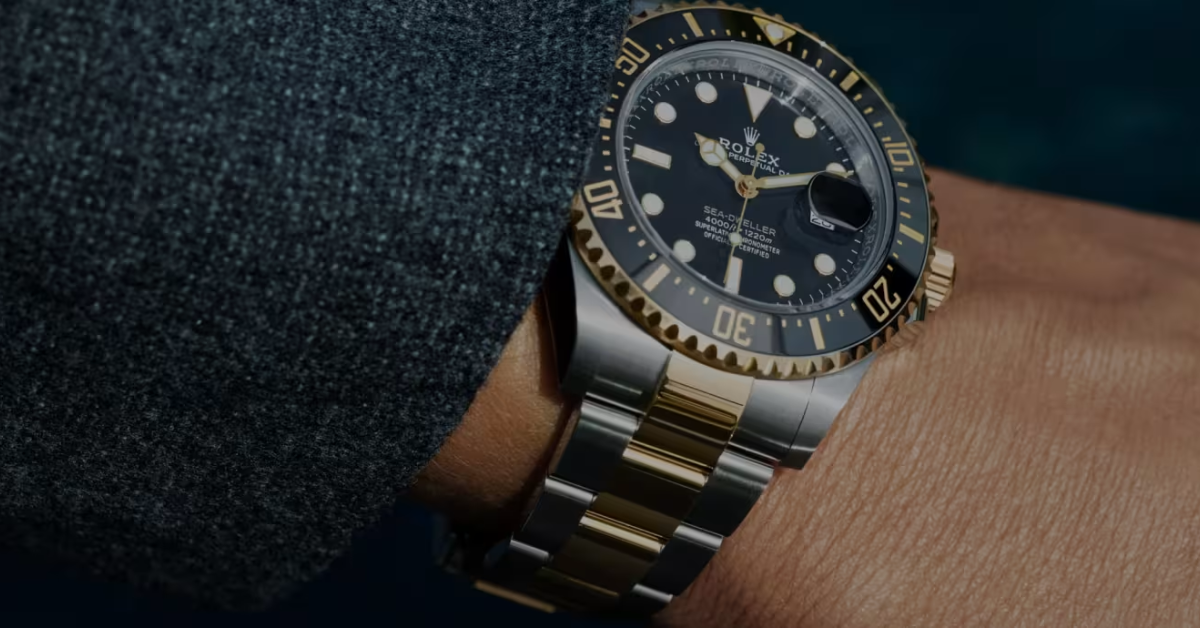
"Perpetual" shows up on nearly every Rolex dial, right below the crown logo, and it's easy to read past it as brand flourish. It isn't. It's a specific, patented engineering claim from 1931 that's still mechanically true of every Rolex made today — the watch winds itself, indefinitely, as long as you wear it. This is what that actually means, how it works, and what's changed about it in the ninety-plus years since.
Where "Perpetual" Actually Comes From
In 1931, Rolex founder Hans Wilsdorf tasked movement maker Aegler — a company Rolex had worked closely with for years and would later acquire outright — with solving a problem that had frustrated watchmakers for generations: build a self-winding mechanism that turns smoothly and silently, without a mechanical buffer jolting the movement.
The result was a free-swinging, semicircular rotor mounted inside the case, weighted so that ordinary wrist movement would cause it to swing back and forth, winding the mainspring continuously. Rolex called it the Perpetual rotor, patented it, and built the first Oyster Perpetual watches around it in 1931. The name has stuck to every Rolex automatic movement since, because the underlying mechanism, refined considerably, is still doing the same job.

How the Rotor Actually Works
The mainspring is the movement's actual power source — a coiled spring that, as it unwinds, drives the gear train that turns the hands. A manually wound watch needs that spring rewound by hand, typically daily. The Perpetual rotor removes that requirement entirely: as the wearer's wrist moves throughout the day, the rotor swings on its pivot, and that motion feeds directly into rewinding the mainspring.
Early versions of this system, including the original 1931 caliber, wound in only one direction — the rotor's swing in the "wrong" direction didn't contribute to winding. That changed in 1950 with the introduction of caliber 1030, which used red-anodized aluminum wheels to enable genuine bi-directional winding — motion in either direction now wound the spring, making the system considerably more efficient at capturing ordinary wrist movement throughout a normal day.
Why the Second Hand Glides Instead of Ticking
This is the most visible everyday signature of a Perpetual movement, and it's worth understanding mechanically rather than just recognizing it by eye. Rolex's current movements oscillate at 28,800 vibrations per hour — 8 beats per second — which is fast enough that the second hand's individual movements blur together into what looks like a smooth, continuous glide rather than a visible tick.
Quartz movements, by contrast, pulse the second hand forward once per second in a single visible jump, because they're governed by an electronic oscillator rather than a mechanical balance wheel. That glide-versus-tick distinction is one of the fastest ways to tell a genuine mechanical Rolex from a quartz watch at a glance — and, worth noting, from most counterfeits, which have historically used cheaper quartz movements. Our field guide to spotting a fake Rolex covers that check in more depth, alongside eight others worth running before you buy.
Chronometer Certification: Two Layers, Not One
Every current Rolex movement carries chronometer certification from the COSC — the Contrôle Officiel Suisse des Chronomètres, an independent Swiss body that tests movements over 15 days and nights under multiple positions and temperatures before granting certification. That's already a meaningful bar; COSC certification is a recognized industry standard, not a Rolex-specific claim.
Rolex then goes a step further. After COSC certification, the fully cased and finished watch — not just the bare movement — undergoes additional testing in Rolex's own laboratories, checking precision, power reserve, water resistance, and self-winding performance under conditions meant to mimic actual wear. Watches that pass earn the "Superlative Chronometer" designation printed on the dial, certified to a tighter tolerance of -2/+2 seconds per day — roughly twice as strict as the COSC's own baseline requirement. It's a two-layer system: independent third-party testing first, then Rolex's own stricter internal standard on top of it.
What's Actually Changed Since 1931
The core concept — a free rotor winding the mainspring through wrist motion — hasn't changed. What has changed is everything around it. Modern Rolex movements, including current calibers like the 3230 used in references such as the Explorer and Submariner, incorporate the Chronergy escapement, a Rolex-developed design that improves efficiency and shock resistance over the traditional Swiss lever escapement. They also use the Parachrom hairspring, made from a Rolex-patented alloy of niobium and zirconium that resists magnetic fields and temperature variation far better than traditional hairspring materials, along with the Paraflex shock-absorption system protecting the balance wheel from impact.
Every component in a current Rolex Perpetual movement is designed and manufactured in-house — a level of vertical integration relatively rare even among high-end Swiss manufacturers, most of which source at least some movement components externally. If you want to see how this movement technology shows up in a specific current model, our Rolex Explorer review covers the caliber 3230 in the context of an actual watch, including its roughly 70-hour power reserve.
Why This History Actually Matters to Buyers
It's easy to treat "Perpetual" as a name that's outlived its literal meaning, the way plenty of legacy brand names have. It hasn't. The word on the dial describes a mechanism that's still physically present and doing its job in every current Rolex automatic — refined across ninety-plus years, but fundamentally the same patented idea Wilsdorf and Aegler solved for in 1931. That's a different kind of claim than most watch marketing makes, because it's verifiable by opening the case back and watching the rotor spin.
FAQ
What does "Perpetual" mean on a Rolex dial? It refers to the self-winding rotor mechanism, patented by Rolex in 1931, that winds the mainspring using the natural motion of the wearer's wrist rather than requiring manual winding.
Do I ever need to manually wind a Rolex Perpetual movement? Under normal daily wear, no — the rotor keeps the mainspring wound continuously. If a watch has been sitting unworn long enough to stop, most references allow manual winding via the crown to restart it.
What's the difference between COSC certification and Rolex's "Superlative Chronometer" designation? COSC certification is an independent third-party standard tested over 15 days; Superlative Chronometer is Rolex's own additional in-house testing on the fully cased watch, certified to a tighter -2/+2 seconds per day tolerance.
Why does a Rolex second hand glide instead of tick? Current Rolex movements oscillate at 28,800 vibrations per hour, fast enough that the second hand's individual movements blur into a smooth sweep, unlike quartz movements, which pulse once per second.
Are all current Rolex movements automatic? Yes — every Rolex currently in production uses a self-winding Perpetual movement; the brand no longer produces manually wound models.
Conclusion
"Perpetual" isn't a legacy name coasting on reputation — it's a literal, working description of a mechanism Rolex patented in 1931 and has spent nearly a century refining rather than replacing. The rotor still swings, the mainspring still winds itself, and the certification standard sitting on top of it is stricter today than it's ever been. Understanding that mechanism is a genuinely useful piece of context whether you're buying your first Rolex or trying to make sense of what separates one from a convincing fake.
Senior Writer
James Whitfield
Senior watch writer with a decade covering Swiss horology, vintage markets and modern releases.