On this page
- 1. The Second-Hand Sweep
- 2. The Cyclops Lens
- 3. Weight and Material Feel
- 4. The Rehaut Engraving
- 5. Case Back Engravings and Serial Numbers
- 6. Dial Printing and Text Alignment
- 7. The Movement, If You Can See It
- 8. Bracelet Links and Clasp Action
- 9. Price and Provenance
- When You're Still Not Sure
- FAQ
- Conclusion
To spot a fake Rolex, check the sweep of the second hand (genuine Rolex movements glide smoothly; most fakes tick), the cyclops lens over the date (genuine Rolex magnifies the date roughly 2.5x, filling the lens), the weight (genuine Rolex uses solid 904L steel or precious metals and feels notably heavy), the engraved rehaut around the dial on models that have one, and the serial and model numbers between the lugs. No single check is definitive on its own — authentication comes from several of these agreeing, not one obvious tell.
Rolex is the single most counterfeited watch brand in the world, which sounds like an exaggeration until you consider the numbers seized at customs checkpoints every year. That popularity cuts both ways: it means fakes have gotten remarkably convincing at a glance, but it also means the authentication process is well understood, tested, and repeatable. You don't need a loupe and a decade of experience to catch most of them — you need to know where counterfeiters consistently cut corners.
This is a field guide, not a lecture. Nine checks, in the order you'd realistically run through them looking at a watch in person.
1. The Second-Hand Sweep
Start here, because it's the fastest test and needs no tools at all.
Genuine Rolex movements are mechanical, running at 28,800 vibrations per hour, which produces a smooth, continuous glide of the second hand rather than a visible tick. Watch it for five seconds. If the second hand jumps in a single motion once per second, that's a quartz movement — no genuine current Rolex uses one. Some higher-quality fakes now use a mechanical movement to fake the sweep, so this test alone can clear an obvious fake but can't confirm authenticity by itself.
2. The Cyclops Lens
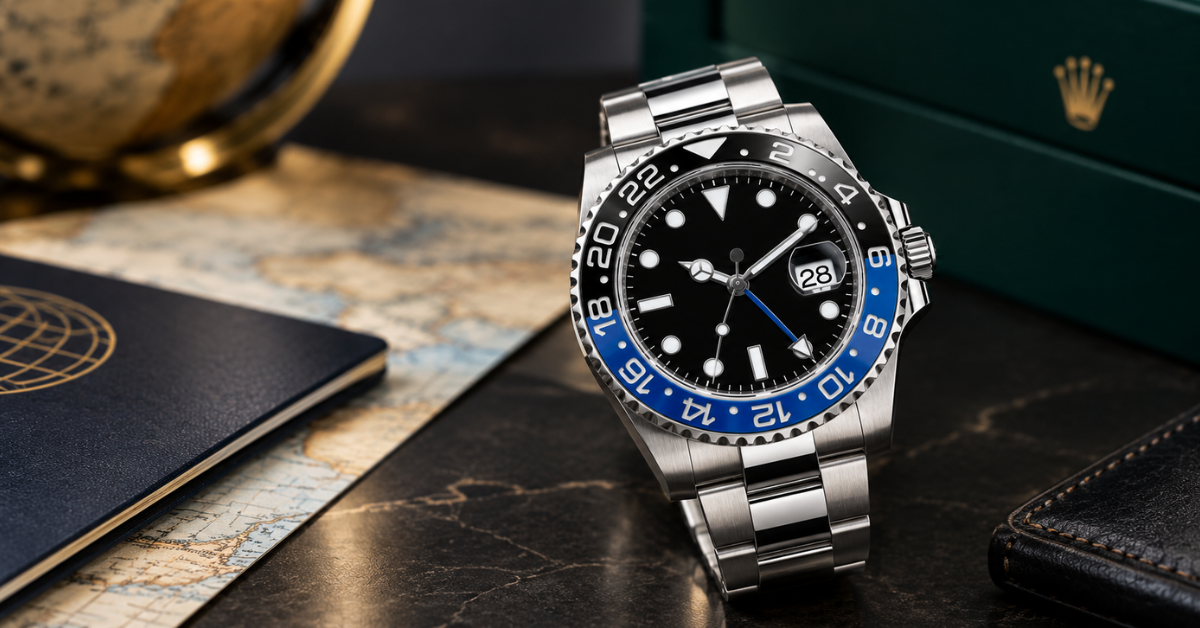
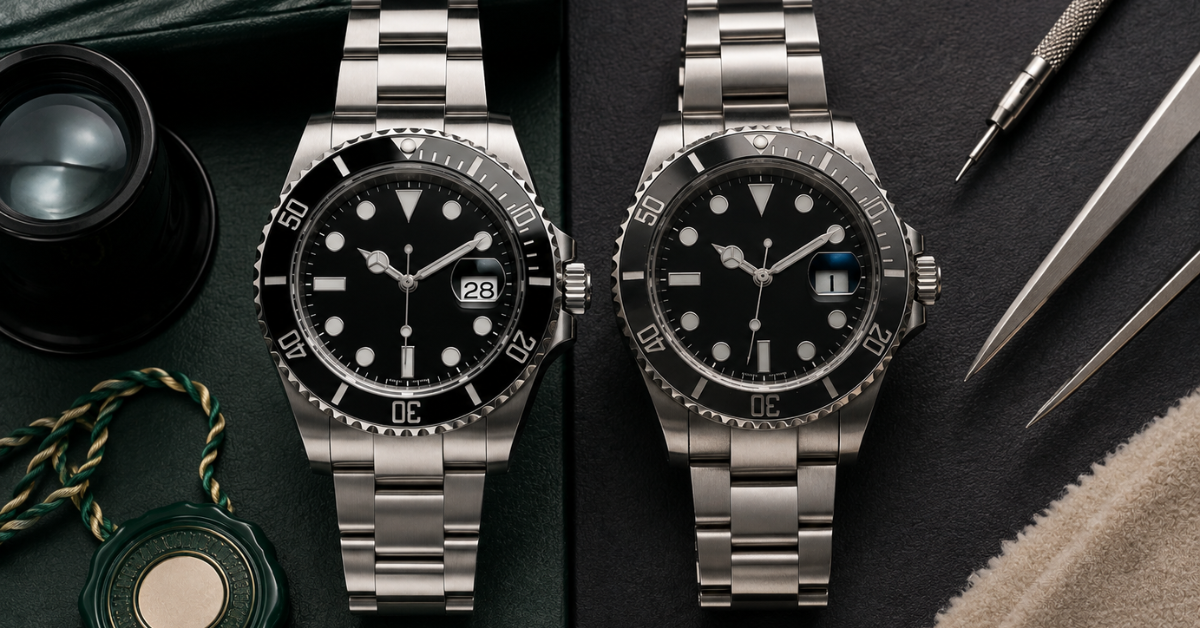
On any Rolex model with a date window — Datejust, Submariner Date, GMT-Master II — there's a small magnifying lens, called the cyclops, set into the crystal above the date. Rolex has used this feature since 1953, and it's engineered to magnify the date by roughly 2.5 times.
On a genuine Rolex, the date fills almost the entire lens and reads clearly straight-on. On most fakes, the magnification is noticeably weaker — the date looks small, slightly off-center, or requires an angle to read clearly. This remains one of the most reliable checks precisely because it's mechanically difficult and expensive to replicate properly.
3. Weight and Material Feel
Rolex uses 904L stainless steel across its steel sports models — a grade more commonly used in the chemical and aerospace industries for corrosion resistance, and notably denser than the 316L steel most fakes and other watch brands use.
The result is a watch that feels heavier than its size suggests, with no hollow or tinny feeling when you tap the case. Precious metal models (Rolesor two-tone, full gold) should feel heavier still. If a Rolex feels light for its size, that's one of the more reliable early red flags, since matching that density requires the same expensive raw materials, not just accurate dimensions.
4. The Rehaut Engraving
Since around 2005, most current Rolex models have a laser-etched inscription running around the inner rim of the case, between the crystal and the dial — the rehaut. It typically repeats "ROLEX" alternating with the crown logo, in a fine, precise engraving that's easy to miss without good lighting.
This detail requires laser engraving equipment and precision that many counterfeiters either skip entirely or execute poorly — shallow, uneven, or misspelled. Tilt the watch under a light and look closely around the full inner rim. Its absence on a model that should have it, or sloppy execution where it's present, is a strong tell.
5. Case Back Engravings and Serial Numbers
Genuine Rolex serial and model numbers are engraved between the lugs at the 6 o'clock position (on pre-2005 models) or on the rehaut itself (on newer models), with crisp, evenly spaced characters. The engraving should feel precise under a fingernail — not shallow, blurred, or inconsistently spaced.
Cross-reference the model number against Rolex's known reference catalog if you can. A number that doesn't correspond to any real Rolex reference, or a serial number sequence that doesn't match the watch's supposed production year, is disqualifying on its own.
6. Dial Printing and Text Alignment
Genuine Rolex dial text — "ROLEX," "OYSTER PERPETUAL," "SUPERLATIVE CHRONOMETER OFFICIALLY CERTIFIED," and model names — is applied with extreme precision. Letters are evenly spaced, symmetrically centered, and sharp-edged even under magnification.
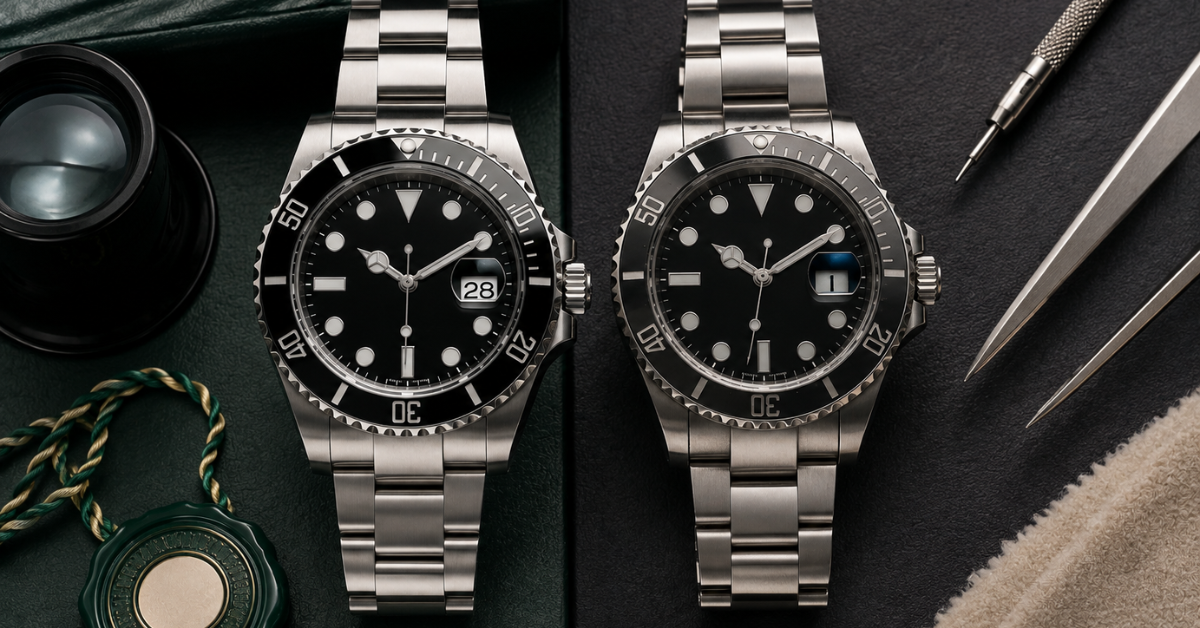
Fakes frequently get subtle details wrong: text slightly off-center, inconsistent letter spacing, a font that's close but not quite right, or printing that looks faintly fuzzy rather than crisp. Compare against verified reference photos of the same model if you're unsure — small inconsistencies here are hard to fake convincingly because Rolex's own quality control tolerances are so tight.
7. The Movement, If You Can See It
Most current Rolex models have a solid case back, not a display back, which is itself worth noting — a Rolex Submariner or Datejust with a clear caseback showing the movement is almost certainly not genuine, since Rolex doesn't currently offer exhibition casebacks on its core sports and dress lines.
If a watch does legitimately have a display back (certain limited or vintage references), the movement should show Rolex's own in-house finishing — Geneva stripes, blued screws, and the Rolex-signature rotor design, engraved and branded, not a generic unmarked automatic movement.
8. Bracelet Links and Clasp Action
Genuine Rolex bracelets use solid links, not hollow stamped ones, which contributes significantly to that overall heavy feel discussed earlier. Links should sit flush with minimal play, and the clasp — Oysterlock or Glidelock depending on the model — should close with a single, confident motion and a distinct click, not require wiggling or multiple attempts.
Counterfeiters have gotten better at bracelet construction in recent years, but hollow links and loose tolerances remain common even on otherwise convincing fakes.
9. Price and Provenance
None of the physical checks above should be strictly necessary if you're buying from the right source, and price is usually the first signal something's off before you even pick up the watch.
A steel sports Rolex significantly below current market price, sold outside an authorized dealer or a reputable, verifiable pre-owned specialist, deserves scrutiny before anything else. Legitimate deals exist, but Rolex's sustained retail scarcity means steep discounts from unfamiliar sellers are far more often a warning sign than a bargain.
When You're Still Not Sure
None of these checks are meant to replace a professional opinion. If you're genuinely uncertain after going through them, an authorized Rolex service center or a reputable independent watchmaker experienced with the brand can settle it definitively, usually within minutes of handling the watch.
For more on what makes a specific Rolex tick beyond authentication — history, movement details, sizing — our current deep dive on the Rolex Explorer is a good next read, and we'll be adding authentication and buying guides for other models to our Guides section as they're published.
FAQ
What's the single easiest way to spot a fake Rolex? The second-hand sweep is the fastest test — a smooth glide indicates a mechanical movement, while a visible tick means quartz, which no genuine current Rolex uses — though it should be combined with other checks since some fakes now fake the sweep too.
Do all genuine Rolex watches have a cyclops lens over the date? No — only models with a date window, such as the Datejust, Submariner Date, and GMT-Master II. Models without a date complication, like the standard Explorer, don't have one at all.
Can a fake Rolex pass a weight test? It's difficult. Genuine Rolex uses dense 904L steel or precious metals, and matching that weight requires the same expensive materials, which most counterfeiters skip in favor of cheaper alloys.
Is a display caseback on a Rolex a red flag? On most current core models — Submariner, Datejust, GMT-Master II — yes, since Rolex doesn't offer exhibition casebacks on those lines; seeing the movement through a clear back on one of these usually indicates a counterfeit.
Where's the safest place to buy a Rolex to avoid fakes entirely? An authorized Rolex dealer for new watches, or a well-established, verifiable pre-owned specialist with a strong reputation and clear return policy for secondhand pieces.
Can a jeweler confirm if my Rolex is real? Yes — an authorized Rolex service center or an experienced independent watchmaker can inspect the movement and case details to confirm authenticity, particularly useful if you're unsure after checking the visual details yourself.
Conclusion
No single check on this list is proof by itself — that's exactly why counterfeiters have gotten as good as they have. What actually works is running through several of these together: the sweep, the cyclops, the weight, the rehaut, the engravings. When three or four of them agree, you have your answer. When in doubt, an authorized dealer or service center will settle it faster than any amount of squinting under a desk lamp.
Senior Writer
James Whitfield
Senior watch writer with a decade covering Swiss horology, vintage markets and modern releases.