On this page
- 1. Test the Subdials, Not Just the Look
- 2. Feel the Pushers and the Crown
- 3. Inspect the Tachymeter Bezel
- 4. Make the Reference, the Caliber and the Caseback Agree
- 5. Study the Dial Print, Then Check the Context
- What These Checks Won't Settle
- FAQ
- What's the quickest way to tell a fake Daytona?
- Do all three Daytona subdials work?
- What movement does a real Daytona have?
- Can a fake Daytona have a working chronograph?
- Should a Daytona have a see-through caseback?
- Do I need a professional to authenticate a Daytona?
- Conclusion
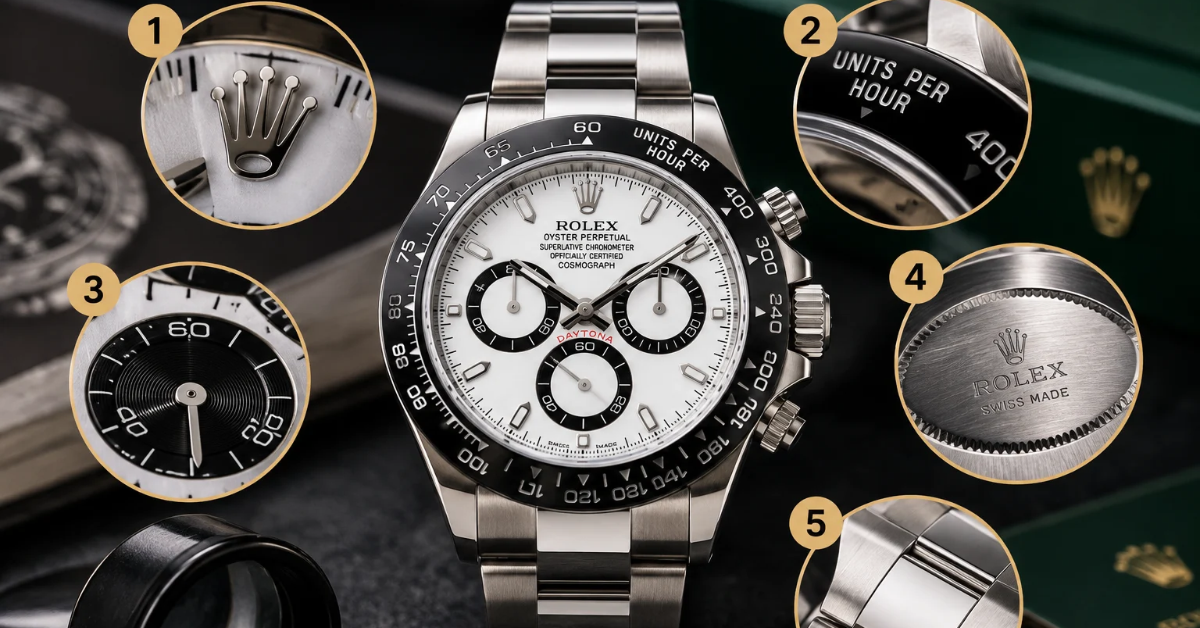
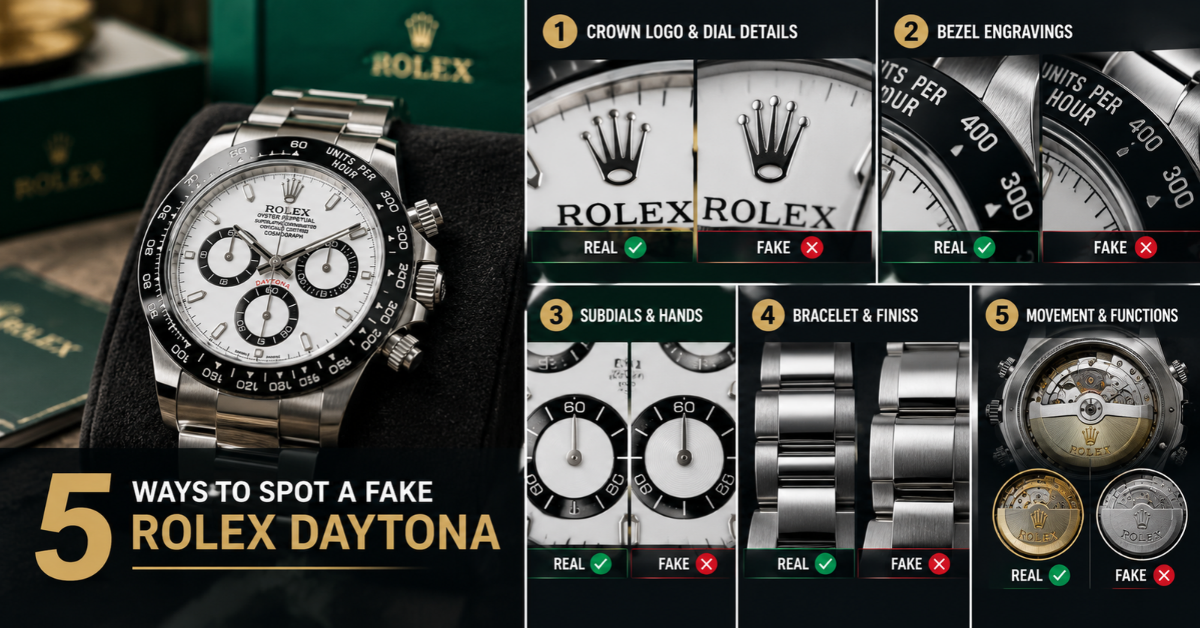
The Daytona is a chronograph, which means it has more moving parts to get wrong than most Rolex models, and that works in your favor. A counterfeiter can copy a dial photograph. Making all the subdials do their job, and making the pushers feel like precision hardware, costs real money. These five checks go after exactly those weak points.
Authentication guides rate the Daytona among the most counterfeited chronographs on the market, so it's worth taking your time. If you're newer to this, start with our field guide to spotting a fake Rolex for the general checks, then use this piece for what's specific to the Daytona.
1. Test the Subdials, Not Just the Look
Start with layout. On a genuine Daytona, the three subdials sit at 3, 6 and 9 o'clock. Cheap fakes often borrow a generic chronograph layout with subdials at 6, 9 and 12, and if the positions are wrong, you can stop right there.
Then make the watch work. A real Daytona's subdials each have a job: small seconds at 9, a 30-minute counter at 3, and a 12-hour counter at 6. Press the top pusher to start the chronograph and watch for three things:
- The central chronograph hand sweeps around the dial.
- The 30-minute counter ticks forward as minutes build.
- The 12-hour counter creeps along over a longer stretch.
Press the same pusher to stop it and the bottom pusher to reset, and everything should snap back to zero. On many counterfeits, the extra subdials are printed decoration: only the small seconds runs, and the other two never move, no matter what you press.One caution. Some higher-end counterfeits do have working chronograph functions, so passing this test is encouraging rather than conclusive. Failing it is close to a verdict.
2. Feel the Pushers and the Crown
A Daytona's pushers screw down against the case, like the crown, and that mechanism shows up in your fingers. Unscrew a pusher and the thread should turn with crisp, even resistance. Press it and you should get a precise click with no side-to-side wobble. Compare that with fakes, where pushers commonly feel mushy or loose, don't sit flush, or respond inconsistently.
The Triplock winding crown is part of the same story: it should wind smoothly and screw down with a firm, clean seat. The Daytona is rated to 100 meters, and the screw-down hardware is why. Hardware that feels cheap, gritty or misaligned is telling you the watch was built to a different standard.
3. Inspect the Tachymeter Bezel
The Daytona's ceramic bezel carries a tachymeter scale for measuring speed. On a genuine watch, the numerals are cut cleanly into the ceramic with a matte, even finish, and the scale text, including "UNITS PER HOUR", is sharp and correctly worded. Look at it under a loupe or a phone macro shot and every character should have the same depth and weight.
Counterfeits tend to show the opposite: shallow cuts, uneven stroke width, blurry edges, or an incorrect scale.Know which generation you're looking at too. Our reference guide explains how to read the number. As a rough guide, the steel 116500LN carries a full ceramic bezel, while the newer 126500LN introduced in 2023 uses a slimmer bezel with a polished steel rim, according to a published reference guide. A bezel that doesn't match the reference it claims is a flag.
4. Make the Reference, the Caliber and the Caseback Agree
This check is about consistency. Modern Daytona references follow a pattern:
- 116xxx (2000 to 2023): Rolex's in-house Caliber 4130.
- 126xxx (2023 onward): Caliber 4131, a revised movement with a Chronergy escapement.
- Earlier 5-digit references like the 16520: a modified Zenith El Primero movement, Caliber 4030.
If a listing says 126500LN but the seller describes a 4130, or the dial and bezel belong to another generation, something has been swapped or invented.The caseback is a similar tell. The standard steel 126500LN has a solid screw-down caseback, so a display back on a watch sold as that reference is suspect. Be careful with this one, though. A few newer precious-metal and special references, including the 2026 Rolesium 126502, do carry sapphire exhibition backs, so check what the specific reference should have before treating either way as proof.
Because most Daytonas hide their movement, confirming the caliber realistically means a watchmaker opening the case. That's exactly what to ask for before paying.
5. Study the Dial Print, Then Check the Context
Under magnification, a genuine Daytona's printing is crisp and consistent. Counterfeit dials commonly show fuzzy letters, uneven spacing between subdial rings, and imprecise chronograph scales. Compare against several verified photos of the exact reference, since different generations differ in finish. For instance, newer dials use vertically brushed subdials with thinner frames where earlier ones were snailed with thicker frames.
Weight helps too. Genuine Daytonas feel dense and solid because of the 904L steel, which we explain in our Oystersteel guide. Watches that feel noticeably light for their size deserve a second look.
Then step back from the watch and look at the sale. Daytonas are scarce at retail, as we cover in our waiting list guide, and scarcity is what makes a "can't-get-one" buyer easy to fool. Our list of seven signs your Rolex might be a fake covers seller behavior, pricing traps and documentation problems that often show up before the watch does.
What These Checks Won't Settle
The best counterfeits get closer every year, and some now include working chronograph movements. No checklist beats a professional. For any Daytona purchase, have the watch opened and inspected by an authorized dealer or an independent watchmaker with Rolex experience before you pay.
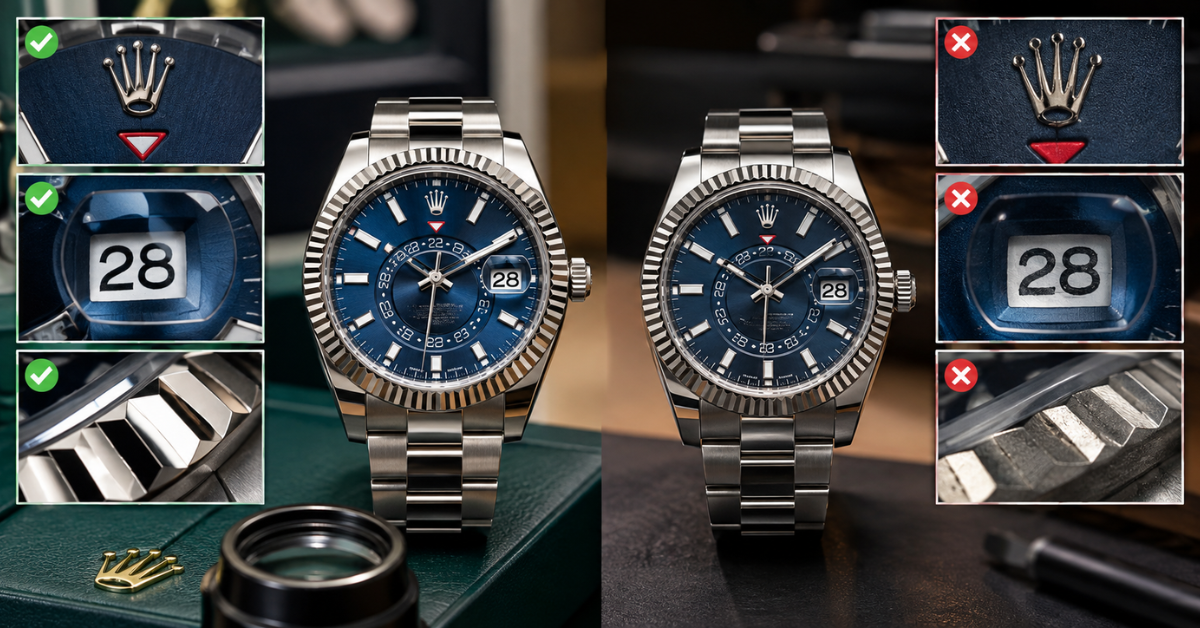
The Daytona is also the model most closely tied to our other authentication guides. If you want a similar functional-test approach on a different complicated Rolex, see our guide to spotting a fake Sky-Dweller, and for a quick check on a dive watch, our 60-second Submariner field test.
If you're still deciding which sports Rolex to chase, our Daytona vs Yacht-Master comparison covers how the two differ.
FAQ
What's the quickest way to tell a fake Daytona?
Test the subdials. A genuine Daytona has them at 3, 6 and 9 o'clock and all three work with the chronograph running. Fakes often have the wrong layout or decorative subdials.
Do all three Daytona subdials work?
Yes. Small seconds at 9, a 30-minute counter at 3 and a 12-hour counter at 6 each have a function, and all reset to zero.
What movement does a real Daytona have?
The in-house Caliber 4130 on 116xxx references (2000 to 2023) and Caliber 4131 on 126xxx references (2023 onward).
Can a fake Daytona have a working chronograph?
Yes. Some better counterfeits do, so a working chronograph is encouraging but not proof.
Should a Daytona have a see-through caseback?
Most steel Daytonas have a solid caseback. A few newer precious-metal and special references have sapphire backs, so check the specific reference.
Do I need a professional to authenticate a Daytona?
For any serious purchase, yes. Have an authorized dealer or experienced independent watchmaker open and inspect it before you pay.
Conclusion
The Daytona's weakness as a target is that it has to work. Press the pushers, run the chronograph and watch all three subdials, then check the bezel, the reference and the dial print. A genuine watch passes each without complaint. When one fails, trust the failure and walk away.
Senior Writer
James Whitfield
Senior watch writer with a decade covering Swiss horology, vintage markets and modern releases.