On this page
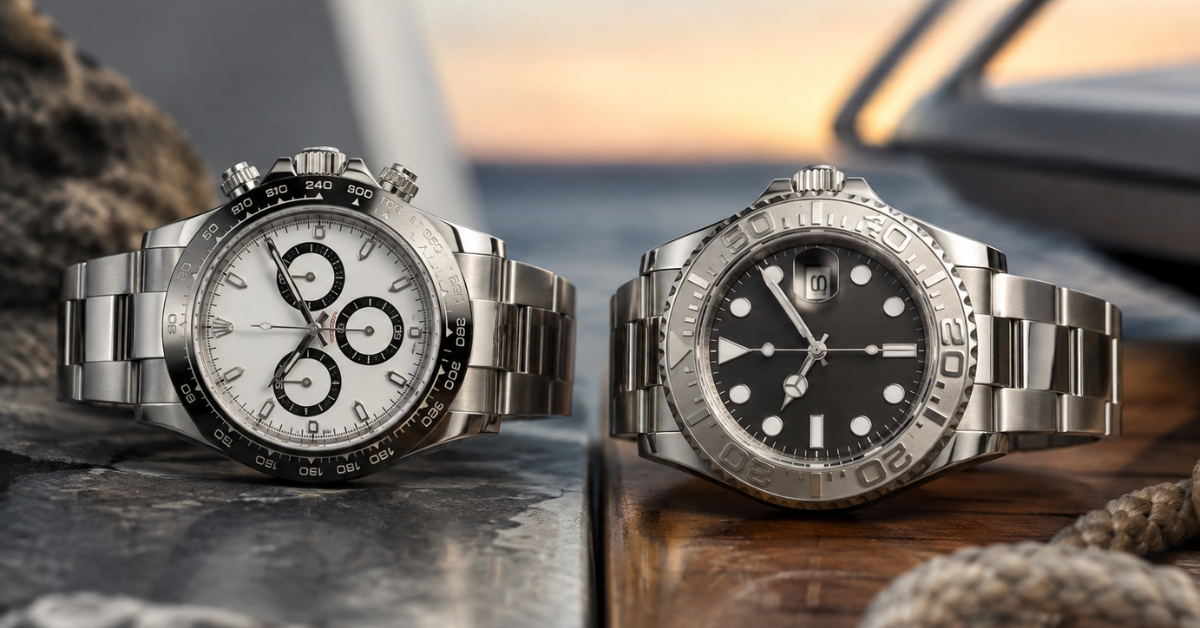
The Rolex Daytona and Yacht-Master are both luxury sports watches, but they're built for genuinely different purposes. The Daytona is a racing chronograph with a tachymeter bezel for measuring speed, carrying extreme scarcity and multi-year waits even for the steel version. The Yacht-Master is a nautical sport watch with a bidirectional rotating bezel for timing sailing starts, offered in a wider range of sizes (37mm, 40mm, 42mm) and materials, with meaningfully better real-world availability. Choose the Daytona for racing heritage and collector cachet; choose the Yacht-Master for a genuinely versatile luxury sport watch you can actually buy without years of waiting.
These two get compared constantly, and the comparison is worth taking seriously, because the two watches solve completely different problems despite both wearing the "Rolex sports watch" label. One is built around motorsport precision; the other around a day on the water. Understanding which job you actually need done makes this decision considerably easier than ranking them against each other in the abstract.
Where Each One Comes From
The Daytona traces back to 1963, introduced specifically for professional racing drivers and named after Daytona Beach's race circuit in Florida. Its entire design vocabulary — the tachymeter bezel, the chronograph subdials — exists to serve one function: letting a driver measure elapsed time and calculate speed at a glance, up to 400 units per hour depending on the scale. It's one of the most recognizable chronographs in the world today, and that recognition traces directly back to genuine motorsport utility, not retroactive marketing.
The Yacht-Master arrived considerably later, in 1992, launching first as an 18-karat yellow gold reference. Its bidirectional rotating bezel serves sailing specifically — timing the countdown to a regatta start, a genuinely different function from the Daytona's speed-calculation bezel. Where the Daytona is a stopwatch built into a case, the Yacht-Master is a nautical timing tool with a more overtly luxurious material presence from day one.
The Function That Actually Separates Them
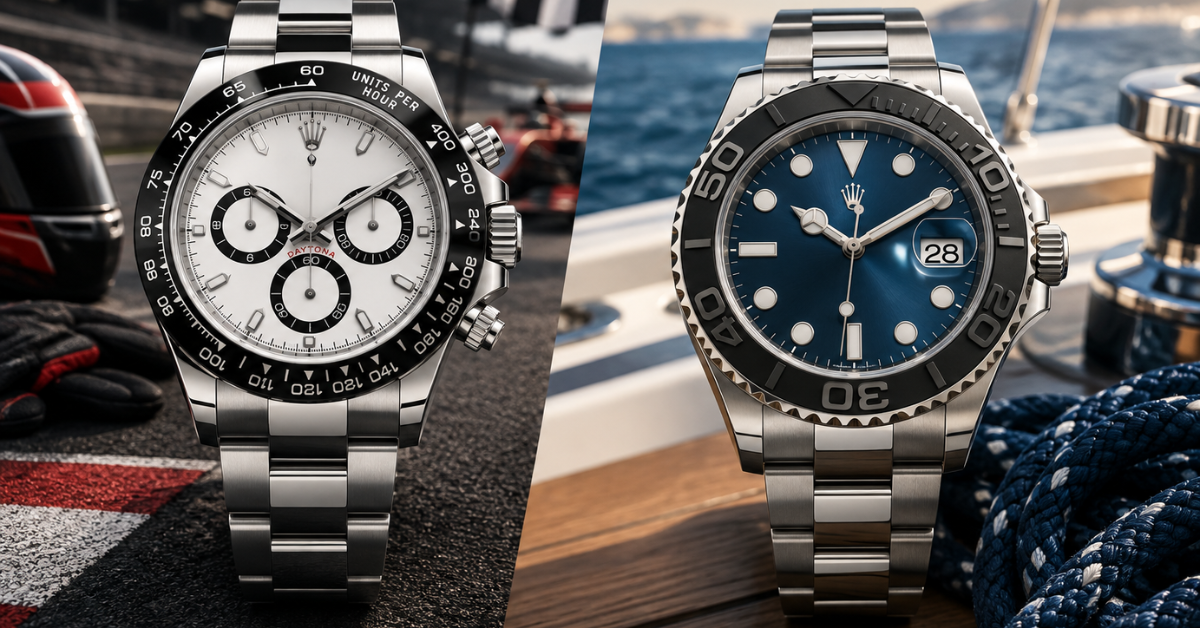
This is worth being precise about, since the two bezels look superficially similar — a ring around the dial with markings — but do genuinely different jobs. The Daytona's fixed tachymeter bezel works together with the chronograph pushers to calculate speed over a measured distance, a function built for racing and only rarely relevant to how most current owners actually use the watch. The Yacht-Master's bezel rotates and counts down, built to time the final minutes before a regatta start — again, a function most current owners don't use in earnest, but the mechanical intent behind each watch still shapes everything else about how it's built and priced.
For buyers who genuinely want a countdown timing function taken further, the Yacht-Master II — a dedicated 44mm regatta chronograph, extensively redesigned for 2026 with a new Caliber 4162 and counterclockwise countdown display — exists specifically for that use case, distinct from the standard time-and-date Yacht-Master covered throughout most of this comparison.
Design and Material Range
The Daytona offers considerably more variety in color, material, and precious stone settings than the Yacht-Master — steel, two-tone, full precious metal, and increasingly elaborate off-catalog configurations, including a 2026 platinum-and-steel "Rolesium" version with a Grand Feu enamel dial. The Yacht-Master, by comparison, offers a narrower color palette but a wider range of case sizes — 37mm, 40mm, and 42mm for the standard model — making it considerably easier to find a genuinely well-fitting size than the Daytona's more fixed sizing.
Both watches run Rolex's current-generation chronometer certification, independently tested and verified to the same rigorous standard covered in our Rolex Perpetual Calibre explainer. The Daytona specifically runs Caliber 4130, a movement developed in-house and widely regarded as one of Rolex's most refined chronograph calibers.
Availability: The Real Deciding Factor for Most Buyers
This is where the comparison becomes less about taste and more about practicality. The Daytona remains one of the hardest Rolex references to acquire at retail, with steel versions in particular still reported as essentially unavailable through normal authorized-dealer channels — buyers routinely wait years or pay significant secondary-market premiums instead. Our coverage of Rolex waitlists in 2026 covers how much the broader catalog's availability has improved this year, with the Daytona standing out as the clear, persistent exception to that improvement.
The Yacht-Master, by contrast, is considerably more attainable. It's not without any wait, but it doesn't carry anywhere near the same allocation friction as the Daytona, making it a realistic near-term purchase for buyers who want a genuine Rolex sports watch without committing to a multi-year relationship with a single authorized dealer.
Pricing: Where the Numbers Actually Land
Yacht-Master pricing generally starts around $11,000 for the 37mm steel model, with Rolesium (steel-and-platinum) 40mm configurations running under $14,000, and precious-metal versions climbing to $30,000 and beyond. The redesigned 2026 Yacht-Master II, at roughly $20,300 in steel, has been specifically flagged by industry analysts as one of the more underpriced pieces of serious watchmaking in Rolex's current catalog relative to what it actually offers mechanically.
Daytona pricing at official retail sits in a broadly comparable range for steel configurations, but that retail figure tells only part of the story — actual transaction prices on the secondary market run considerably higher given the scarcity discussed above, and off-catalog or precious-metal Daytona references can reach well into six figures. For a sense of how allocation scarcity affects pricing on another hyped Rolex sports reference, our coverage of Submariner pricing by reference illustrates the same dynamic at a more accessible price point.
Servicing Considerations
Both watches carry more complex movements than Rolex's simpler three-hand references, which shows up in service costs. Our Rolex servicing costs guide covers the Daytona's chronograph movement specifically — generally the more expensive of the two to service given the added complexity of a chronograph's additional components, worth factoring into long-term ownership costs regardless of which watch you choose.
So, Which One Actually Fits You?
- Want racing heritage, maximum collector cachet, and don't mind a genuine wait or premium? The Daytona earns its reputation honestly, and nothing else in Rolex's catalog matches its recognition or resale story.
- Want a genuinely versatile, nautical-styled luxury sport watch you can realistically buy this year? The Yacht-Master delivers real Rolex engineering and design distinction without the Daytona's allocation problem.
- Specifically want a functional regatta countdown tool rather than a general sport watch? The redesigned Yacht-Master II is worth serious consideration on its own terms.
- Care primarily about wearing a genuinely capable Rolex sports watch sooner rather than later? That practical reality alone pushes most buyers toward the Yacht-Master, regardless of which watch they'd choose in a world without waitlists.
FAQ
Is the Rolex Daytona or Yacht-Master harder to buy? The Daytona, by a significant margin — steel versions in particular remain difficult to find at retail, while the Yacht-Master is considerably more attainable through normal authorized-dealer channels.
What's the functional difference between the Daytona and Yacht-Master bezels? The Daytona's fixed tachymeter bezel works with its chronograph to calculate speed, while the Yacht-Master's bidirectional rotating bezel is built to time a countdown, originally for regatta starts.
Which is more expensive, the Daytona or Yacht-Master? Retail pricing sits in a broadly similar range for steel configurations, but the Daytona commands considerably higher prices on the secondary market due to its scarcity, while the Yacht-Master trades closer to retail.
Does the Yacht-Master come in more sizes than the Daytona? Yes — the standard Yacht-Master offers 37mm, 40mm, and 42mm case sizes, a wider range than the Daytona's more fixed sizing.
Is the Yacht-Master II the same as the standard Yacht-Master? No — the Yacht-Master II is a dedicated 44mm regatta chronograph with a programmable countdown function, redesigned for 2026, distinct from the standard time-and-date Yacht-Master.
Conclusion
The Daytona and Yacht-Master aren't really competing for the same buyer once you look past the shared "Rolex sports watch" label — one is a racing chronograph built around scarcity and motorsport heritage, the other a nautical luxury sport watch built around genuine day-to-day versatility and real-world availability. Both are excellent watches on their own terms. The honest deciding factor for most buyers isn't which one is better — it's which job you actually need the watch to do, and how much waiting you're genuinely willing to accept to get it.
Senior Writer
James Whitfield
Senior watch writer with a decade covering Swiss horology, vintage markets and modern releases.