On this page
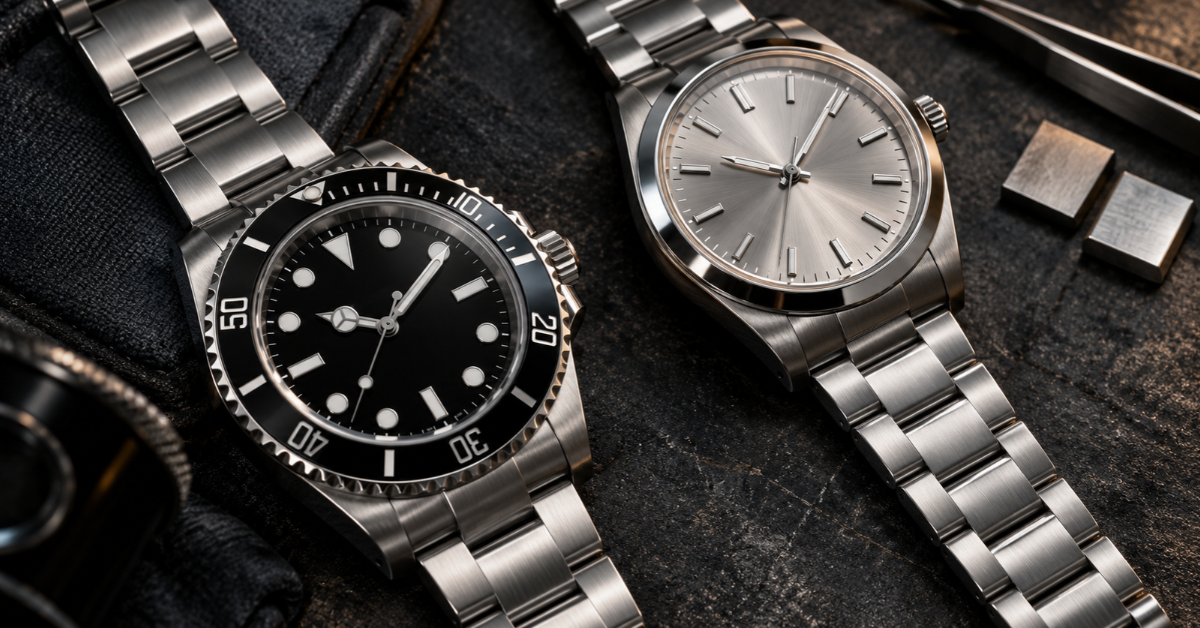
"Oystersteel" sounds like it might be some proprietary Rolex invention, a secret metal nobody else has access to. It isn't, and clearing that up actually makes the real story more interesting, not less.
It's Real, Chemically Defined Stainless Steel
Oystersteel is Rolex's branded name for 904L, a specific grade of austenitic stainless steel. It's not a Rolex invention—904L existed before Rolex adopted it, originally developed for chemical processing and aerospace applications where resistance to aggressive substances like sulphuric acid and chlorides mattered more than watchmaking ever had. What Rolex did was recognize its potential for watch cases, refine the production process through its own foundry, and eventually put a consumer-facing name on it.
The Actual Chemistry, Compared
This is where the real difference between the two lives, and it's precise rather than vague. Standard 316L stainless steel—the grade used by most other major watch brands, including Omega, TAG Heuer, and Breitling—generally contains 16 to 18% chromium, 10 to 14% nickel, and 2 to 3% molybdenum. Rolex's 904L contains meaningfully more of all three: roughly 19 to 23% chromium, 23 to 28% nickel, and 4 to 5% molybdenum, with the addition of 1 to 2% copper, an element 316L doesn't contain at all.
That extra chromium, nickel, and molybdenum is what gives 904L its improved resistance to corrosion, and the copper is part of what lets it take a brighter, more consistent polish. Both are genuinely stainless steel alloys—904L is simply a higher grade within that same broad material family, not a separate category of metal.
Why Rolex Actually Switched
The story behind the switch is more practical than marketing-driven, and it's worth knowing. Rolex began using 904L in 1985, becoming the first watchmaker to use it at scale, after noticing a real problem: dive watches returning to service centers with corrosion where saltwater and sweat had worked into the screw threads, causing pitting in the standard 316L steel of the era. Our coverage of the Sea-Dweller vs Deepsea touches on the broader engineering priorities behind Rolex's dive watch lineage—corrosion resistance in genuinely harsh, sustained saltwater exposure was exactly the kind of problem 904L was built to solve.
Rolex initially used 904L only on the Sea-Dweller and later the Submariner, the models most exposed to that saltwater environment. By 2003, the brand had switched its entire steel lineup over to 904L, extending the benefit across the catalog rather than limiting it to dive watches specifically.
The 2018 Rename
For decades, Rolex's own literature simply referred to the material as "904L steel." That changed at Baselworld 2018, when Rolex introduced "Oystersteel" as the consumer-facing name, without any change to the underlying alloy itself. It's a genuine rebrand, not a new material launch—the chemistry Rolex had been using since 1985 got a name that fit better alongside the "Oyster" case and "Perpetual" movement in Rolex's broader product language.
What It Actually Improves, and What It Doesn't
This is worth being precise about, since it's an area where marketing enthusiasm tends to outrun the real engineering claim. 904L's genuine, well-documented advantages are corrosion resistance—particularly against saltwater, sweat, and long-term environmental exposure—and its ability to polish to a brighter, more consistent shine, largely thanks to the copper content.
What it doesn't meaningfully improve is hardness or scratch resistance. In real-world use and in direct comparisons, 904L and 316L perform similarly against everyday scratching; the finished watches end up at roughly comparable hardness levels. If you've heard that Oystersteel is dramatically more scratch-resistant than standard stainless steel, that's not well supported—the real, documented advantage is how the metal ages and resists corrosion over years of wear, not how it holds up against a single scrape.
Why Other Brands Don't Use It
If 904L is genuinely better for corrosion resistance, a fair question is why more of the industry hasn't switched. The honest answer is that 904L is harder to machine than 316L, adding real cost and complexity to production — Rolex's scale and manufacturing investment made that trade-off worthwhile in a way it hasn't for most other brands, who've found 316L's corrosion resistance more than adequate for typical use and easier to work with in production.
Why This Matters Beyond Trivia
Material composition connects directly to authentication, too. Genuine Oystersteel construction contributes to the specific weight and density that makes weight one of the more reliable physical checks against counterfeits — our general field guide to spotting a fake Rolex and our Submariner pricing by reference guide both touch on how genuine material construction plays into a watch's overall feel and value, whether you're checking authenticity or evaluating a specific reference.
FAQ
Is Oystersteel a different metal from stainless steel? No — Oystersteel is Rolex's name for 904L, a specific high grade of stainless steel, not a separate category of material.
What's the actual chemical difference between Oystersteel and standard stainless steel? 904L contains roughly 19 to 23% chromium, 23 to 28% nickel, 4 to 5% molybdenum, and 1 to 2% copper, compared to standard 316L's roughly 16 to 18% chromium, 10 to 14% nickel, and 2 to 3% molybdenum with no copper.
When did Rolex start using 904L steel? 1985, initially on the Sea-Dweller and later the Submariner, in response to corrosion problems in saltwater-exposed dive watches, before extending it across the entire lineup by 2003.
Is Oystersteel more scratch-resistant than regular stainless steel? Not meaningfully — its real, well-documented advantages are corrosion resistance and polish quality, not hardness or scratch resistance, which perform similarly to standard 316L in practice.
Why don't other watch brands use 904L like Rolex does? It's harder and more costly to machine than the industry-standard 316L, and most brands have found 316L's corrosion resistance sufficient for typical use without that added production complexity.
Conclusion
Oystersteel isn't a mystery alloy or a marketing fiction — it's real 904L stainless steel, refined by Rolex's own foundry and renamed for consumer branding in 2018. The genuine story is a corrosion problem Rolex solved in 1985 with a harder-to-work material most of the industry still hasn't bothered adopting, not a secret metal nobody else can access. Knowing the real chemistry behind the name makes the claim considerably more credible, not less.
Reviews Editor
Sofia Marchetti
Reviews editor focused on dive watches, chronographs and everyday wearability.