On this page
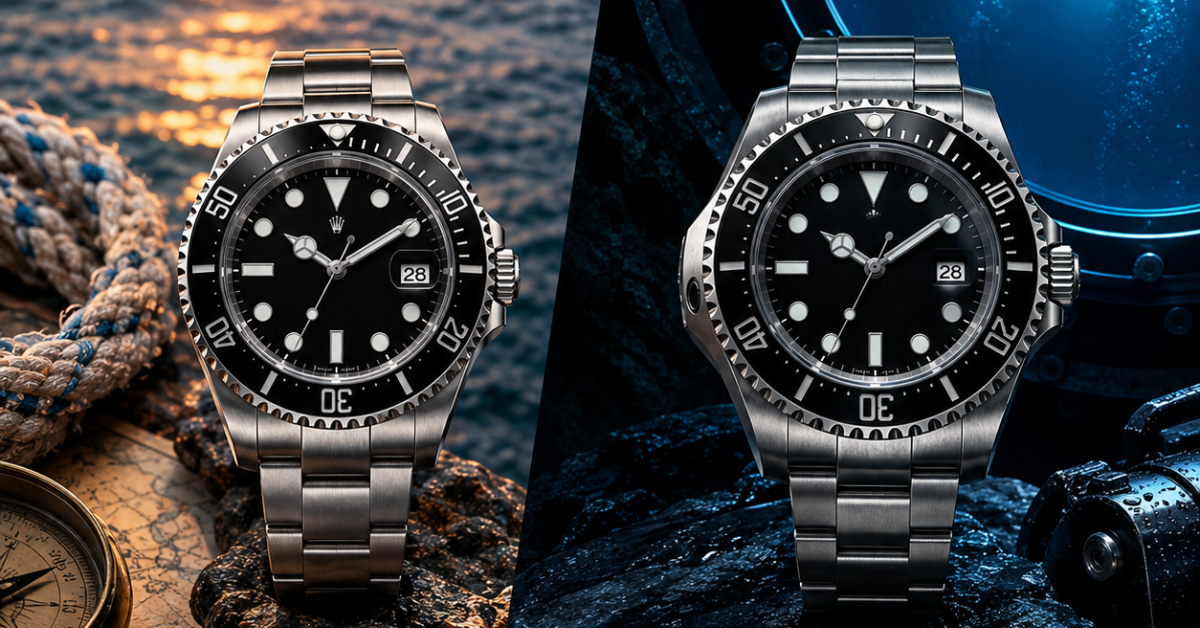
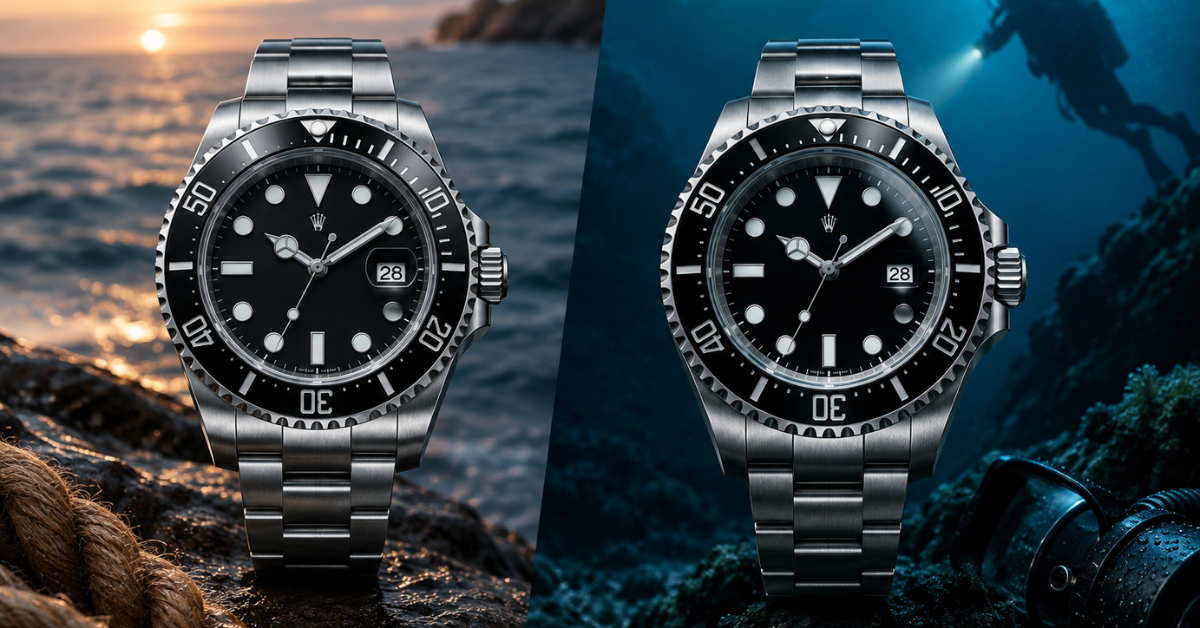
The Rolex Sea-Dweller is rated to 1,220 meters in a 43 mm case, while the Deepsea reaches 3,900 meters in a considerably larger, heavier 44 mm case built around Rolex's patented Ringlock System. Both figures vastly exceed what any diver, professional or recreational, will ever need in practice—commercial saturation diving rarely approaches even the Sea-Dweller's rating. The honest answer to "how deep do you need to go" is neither: this decision should come down to size, weight, and price, not depth capability, since both watches are already engineered far beyond any real-world requirement.
Depth rating is the number most people reach for first when comparing these two, and it's genuinely the least useful one for making an actual buying decision. Both watches are engineered to survive pressures no diver, professional or otherwise, will realistically encounter. The real differences that should drive your choice are size, weight, and the genuinely fascinating engineering that makes the Deepsea's extreme rating possible in the first place.
Why the Sea-Dweller Exists at All
The Sea-Dweller's origin is a real engineering fix for a real problem, not a marketing invention. Introduced in 1967, it was built specifically for commercial saturation divers who kept losing crystals off their submarines. During decompression, helium that had seeped into the watch case at depth expanded faster than it could escape through the normal seals—enough pressure buildup to blow the crystal clean off. Rolex's fix was the helium escape valve, a one-way valve in the case side that vents trapped helium during decompression while still keeping water out at depth. That valve is the entire reason the Sea-Dweller exists as a distinct model from the Submariner, and it remains the defining feature separating both watches in this comparison from Rolex's standard dive lineup.
The original 1967 Sea-Dweller carried a water resistance rating of 610 meters; by 1978, Rolex had improved it to 1,220 meters, where it remains today. The current reference, 126600, introduced in 2017 for the line's 50th anniversary, runs a 43mm Oystersteel case with a black Cerachrom bezel, Rolex's current Caliber 3235 movement, and the red "SEA-DWELLER" text on the dial that's become the model's visual signature. It weighs approximately 165 grams on the bracelet. For pricing context on Rolex's more mainstream diver, our Submariner pricing by reference guide covers the watch the Sea-Dweller was originally built to improve upon.
The Deepsea: Named After an Actual Historic Dive
The Deepsea's story is even more directly tied to real exploration. Its name references the Deep Sea Special, an experimental Rolex watch strapped to the outside of the bathyscaphe Trieste during its historic 1960 descent to the bottom of the Mariana Trench — genuine extreme-depth history, not a name chosen for effect. Rolex introduced the modern production Deepsea in 2008, and the connection to real deep-sea exploration continued in 2012, when a special Deepsea Challenge prototype — 51.4mm, rated to an almost incomprehensible 12,000 meters — accompanied filmmaker James Cameron's solo dive to Challenger Deep, the deepest known point in the ocean. Rolex built that specific prototype in just 53 days using the standard Deepsea as a template. The current production Deepsea includes a blue gradient dial variant specifically commemorating that 2012 expedition, alongside the standard black dial version.
The Ringlock System: How 3,900 Meters Is Actually Possible
This is genuinely worth understanding, because it's the real engineering story behind the Deepsea's extreme capability, not just a bigger number stamped on the caseback. Rather than scaling up conventional case construction, Rolex built the Deepsea around a patented system called Ringlock — a nitrogen-alloyed steel compression ring sitting inside the case between the crystal and caseback, paired with a thick, domed sapphire crystal (5 to 5.5mm) and a titanium caseback that flexes slightly under pressure. As depth pressure increases, the crystal and caseback press inward against that internal steel ring, which redirects the force away from the case structure itself rather than letting it bear directly on the crystal and seals the way conventional dive-watch construction does.
The result is a watch that achieves roughly three times the Sea-Dweller's pressure resistance while actually staying about 10% thinner than it would need to be using more conventional deep-dive engineering approaches. It's a genuinely different solution to the depth-rating problem, not simply a scaled-up Sea-Dweller.
Size and Weight: Where You'll Actually Feel the Difference
This is the comparison that matters for daily wear, and it's a real, noticeable gap. The Sea-Dweller's 43mm case weighs approximately 165 grams; the Deepsea's 44mm case, at roughly 17.7mm thick — genuinely substantial — weighs about 210 grams. That's a meaningful difference on the wrist, not a rounding error, and it's worth trying both on in person before assuming the Deepsea's added capability is worth its added bulk. The Deepsea is built for a larger wrist and a wearer who specifically wants that bold, heavy presence; the Sea-Dweller wears as the more restrained, genuinely daily-wearable option of the two despite its own substantial specifications.
Pricing
The current Sea-Dweller 126600 generally trades in the $11,000 to $13,000 range on the secondary market, while the older, discontinued 16600 reference (produced until 2008) trades lower, typically $7,000 to $10,000. The Deepsea starts meaningfully higher, generally above $13,000 at retail, reflecting the added Ringlock engineering and titanium construction. Our Rolex servicing costs guide is worth checking too — the Deepsea's more complex case construction is a real factor in long-term ownership costs beyond the purchase price itself.
So, How Deep Do You Actually Need to Go?
Here's the honest answer: neither watch's depth rating should be the deciding factor, because both numbers are so far beyond genuine necessity that the difference is essentially theoretical for every realistic owner. Recreational diving rarely goes beyond 40 meters. Even professional and technical saturation diving, the exact use case the Sea-Dweller was built to serve in 1967, rarely approaches anywhere close to 1,220 meters in practice. The Deepsea's 3,900-meter rating exists mainly as a genuine engineering showcase and a connection to real historic exploration — not a specification any current owner will ever test, or need to.
That reframes the actual decision usefully. If you like the idea of Rolex's most extreme engineering and don't mind the larger, heavier case, the Deepsea earns its reputation honestly through the Ringlock System and its genuine connection to deep-sea history. If you want a still-serious professional dive watch — one that comfortably covers any real diving scenario with room to spare — in a more wearable daily package, the Sea-Dweller delivers that without the Deepsea's added bulk or price.
Buying With Confidence
Given the values involved, buying from an authorized source or a verified reputable dealer removes any authentication risk on either watch. Our field guide to spotting a fake Rolex covers checks worth running before any high-value purchase, new or pre-owned.
FAQ
What's the actual difference between a Rolex Sea-Dweller and Deepsea? The Sea-Dweller is rated to 1,220 meters in a 43mm case; the Deepsea reaches 3,900 meters in a larger, heavier 44mm case built around Rolex's patented Ringlock System, which redirects pressure away from the case using an internal steel compression ring.
Do I actually need a watch rated to 3,900 meters? No — even professional saturation diving rarely approaches the Sea-Dweller's 1,220-meter rating in practice, so the Deepsea's extreme depth capability functions more as engineering showcase and collector interest than genuine necessity for any realistic owner.
Why is the Sea-Dweller called that specifically? It was introduced in 1967 with a helium escape valve, invented to solve a real problem where saturation divers were losing crystals off their Submariners as trapped helium expanded during decompression.
What is Rolex's Ringlock System? A patented case construction unique to the Deepsea, using a nitrogen-alloyed steel compression ring, a thick domed sapphire crystal, and a flexing titanium caseback to redirect extreme pressure away from the case rather than relying on conventional seals alone.
Which is more expensive, the Sea-Dweller or Deepsea? The Deepsea, generally starting above $13,000, compared to the current Sea-Dweller's roughly $11,000 to $13,000 secondary-market range.
Conclusion
Both of these watches are engineered to survive depths no realistic owner will ever actually reach, which means the real decision has nothing to do with how deep either one can go. It comes down to size, weight, and whether the Deepsea's genuinely remarkable Ringlock engineering and deep-sea exploration pedigree are worth the added bulk and price over the Sea-Dweller's more wearable, still thoroughly capable alternative.
Senior Writer
James Whitfield
Senior watch writer with a decade covering Swiss horology, vintage markets and modern releases.