On this page
- Where Each One Actually Comes From
- Build and Materials: The Real Gap
- Movement: Two Different Philosophies
- Water Resistance and Bezel Action
- Price: A Genuinely Different Universe
- So, Which Should You Actually Buy?
- Servicing and Long-Term Ownership
- Buying With Confidence
- FAQ
- Is a Seiko 5 basically a cheaper version of the Rolex Submariner?
- How much more does a Submariner cost than a Seiko 5?
- Is the Seiko 5 a good first automatic watch?
- What does the Submariner's price actually buy compared to a Seiko 5?
- Should I buy a Seiko 5 or save for a Submariner?
- Why Choose us?
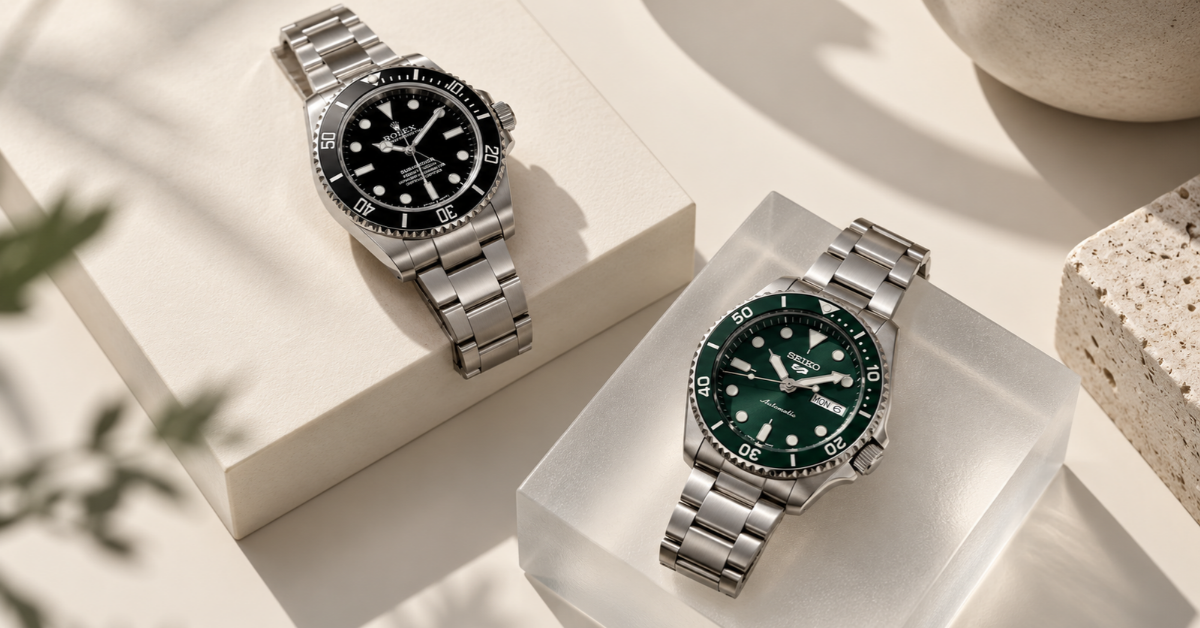
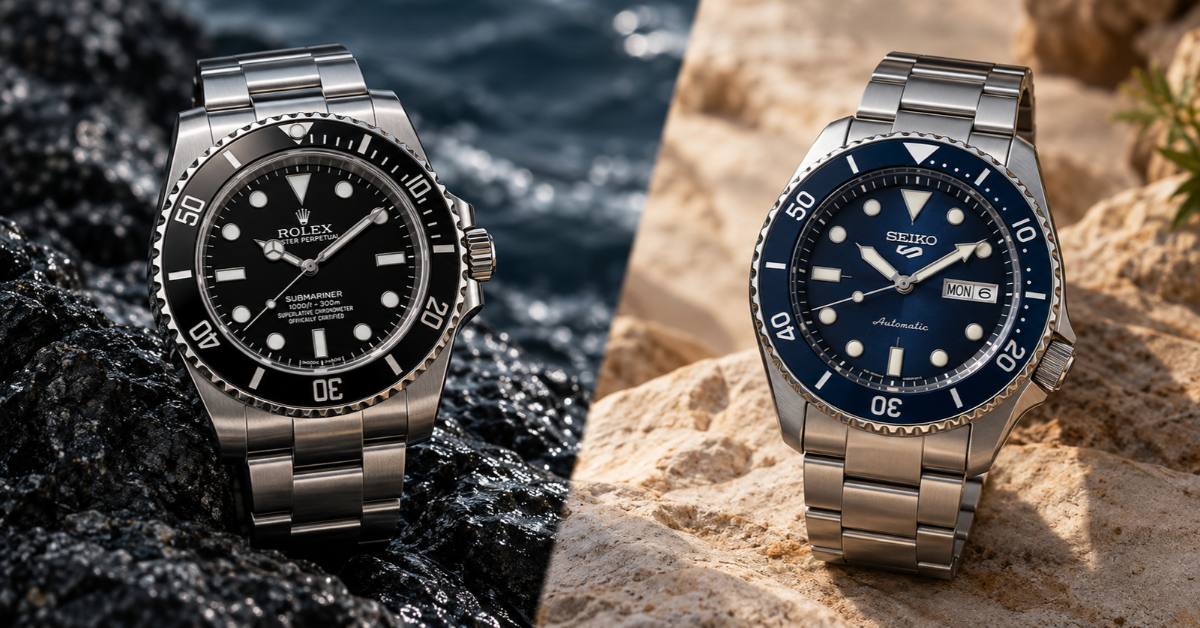
This comparison shows up constantly in beginner watch forums, usually from someone wondering whether their Seiko is "basically a mini Submariner." It isn't, and it also isn't trying to be. This covers what actually separates them, and why the gap between a $300 watch and a $10,000 one is more informative than it might seem.
Where Each One Actually Comes From
The Submariner debuted in 1953, and its rotating bezel, luminous markers, and case proportions became the reference point the entire dive-watch category has measured itself against ever since. Our Submariner pricing by reference guide covers its current lineup and what specific references actually cost today.
Seiko's own diving heritage runs deep and independently — the brand built genuine professional dive watches starting in the 1960s, developing its own case and bezel solutions rather than simply copying anyone else's. The current Seiko 5 traces back to 1963 and was built around five defining principles: automatic winding, a day-date display, water resistance, a recessed crown, and durable case construction. Some Seiko 5 references borrow visual cues common across the whole dive-watch category — a rotating bezel, a cushion case, bold luminous markers — but that's a shared design language the category evolved together, not a case of one specific model copying the Submariner alone.
Build and Materials: The Real Gap
This is where the price difference actually shows up, and it's worth being specific rather than vague about it. The Submariner uses 904L steel, a corrosion-resistant alloy more commonly associated with aerospace and chemical processing than watchmaking, paired with a Cerachrom ceramic bezel insert that resists scratching and fading, and sapphire crystal throughout. The Seiko 5 uses standard steel construction, an aluminum bezel insert that can fade or scratch over years of wear, and Hardlex, a scratch-resistant but genuinely softer mineral crystal than sapphire.
Neither approach is dishonest about what it is. The Seiko 5's materials are entirely appropriate for its price point and deliver real durability for daily wear. The Submariner's materials reflect a different manufacturing standard, and that standard is a meaningful part of what the price actually buys.
Movement: Two Different Philosophies
The Submariner runs Rolex's in-house Caliber 3235, delivering a 70-hour power reserve and full Superlative Chronometer certification to a stated accuracy of -2/+2 seconds a day, independently tested to that standard. Our Rolex Perpetual Calibre explainer covers what that in-house engineering and certification process actually involves.
The Seiko 5's 4R36 delivers a 41-hour power reserve, with a published factory tolerance of +45/-35 seconds a day, though real-world examples commonly perform closer to plus or minus 10 to 15 seconds daily. It's a proven, widely serviced movement with a genuinely strong reliability track record, just built to a different cost and precision target than an in-house Rolex caliber.
Water Resistance and Bezel Action
The Submariner is rated to 300 meters, using a bezel that rotates in 120 precise clicks per full turn, with a satisfying, tightly toleranced mechanical feel. The Seiko 5's dive-styled references generally offer 100 meters, with a bezel action that's serviceable but doesn't match the same manufacturing precision. Both figures comfortably exceed what recreational swimming or snorkeling actually requires — the practical difference between them shows up more in daily handling feel than in any real-world depth scenario either watch is likely to see.
Price: A Genuinely Different Universe
Current Submariner pricing starts around $10,050 for the no-date 124060, climbing from there across the current lineup. The Seiko 5 sits at $200 to $350. That's not a premium-versus-budget comparison in the way a Tissot-versus-Seiko matchup might be — it's roughly a 30 to 50 times price difference, reflecting genuinely different manufacturing philosophies, materials, brand positioning, and, for the Rolex specifically, the scarcity dynamics covered in our Rolex waitlists guide.
So, Which Should You Actually Buy?
Neither answer makes the other a mistake, and it's worth resisting the urge to declare a winner here.
- Want a genuinely reliable, low-risk first automatic watch, and don't need in-house engineering or precious-grade materials? The Seiko 5 does exactly what it promises, honestly, at a price that lets you learn what you actually like about mechanical watches before spending more.
- Want the watch that defined the category, built to a materials and certification standard few brands match, and you have the budget for it? The Submariner earns its price through genuine manufacturing standards, not just a name on the dial.
- Already own a Seiko 5 and wondering if a Submariner is the "next step"? For a lot of enthusiasts, it genuinely is — starting with an accessible automatic and working toward something like a Submariner later is one of the more common paths into this hobby, not a contradiction.
Servicing and Long-Term Ownership
The Submariner sits in Rolex's most accessible service tier, generally around $800 to $950 for a complete overhaul at an authorized Rolex Service Center — our servicing costs guide covers what that actually includes. The Seiko 5, by contrast, is inexpensive enough that many owners simply replace rather than service one that eventually wears out, though genuine servicing is also widely available through Seiko's own network.
Buying With Confidence
If you're specifically shopping for a Submariner, given how frequently it's counterfeited, buying from an authorized source removes any authentication risk. Our 60-second Submariner field test and our general field guide to spotting a fake Rolex cover the checks worth running before any purchase.
FAQ
Is a Seiko 5 basically a cheaper version of the Rolex Submariner?
Not really — Seiko has its own independent diving heritage dating to the 1960s, and while some Seiko 5 references share visual cues common across the dive-watch category, the two watches differ substantially in materials, movement, and manufacturing standard.
How much more does a Submariner cost than a Seiko 5?
Roughly 30 to 50 times more — the Submariner starts around $10,050, compared to $200 to $350 for a Seiko 5.
Is the Seiko 5 a good first automatic watch?
Yes — it's widely considered one of the lowest-risk entry points into mechanical watches, with a proven, widely serviced movement.
What does the Submariner's price actually buy compared to a Seiko 5?
In-house movement engineering with independent chronometer certification, 904L steel construction, a ceramic bezel, sapphire crystal, and Rolex's own manufacturing and service standards.
Should I buy a Seiko 5 or save for a Submariner?
It depends on your goals — many enthusiasts start with a Seiko 5 to learn what they enjoy about mechanical watches, then work toward a Submariner or similar watch later, and neither choice is a wrong one.
Why Choose us?
Comparing these two isn't really about picking a winner — it's about understanding what a watch's price is actually paying for at each end of the market. The Seiko 5 delivers honest, reliable value at its price point. The Submariner delivers genuine manufacturing standards, in-house engineering, and category-defining heritage at a price that reflects all three. Both can be exactly the right watch, just for different moments in owning one.
Senior Writer
James Whitfield
Senior watch writer with a decade covering Swiss horology, vintage markets and modern releases.