On this page
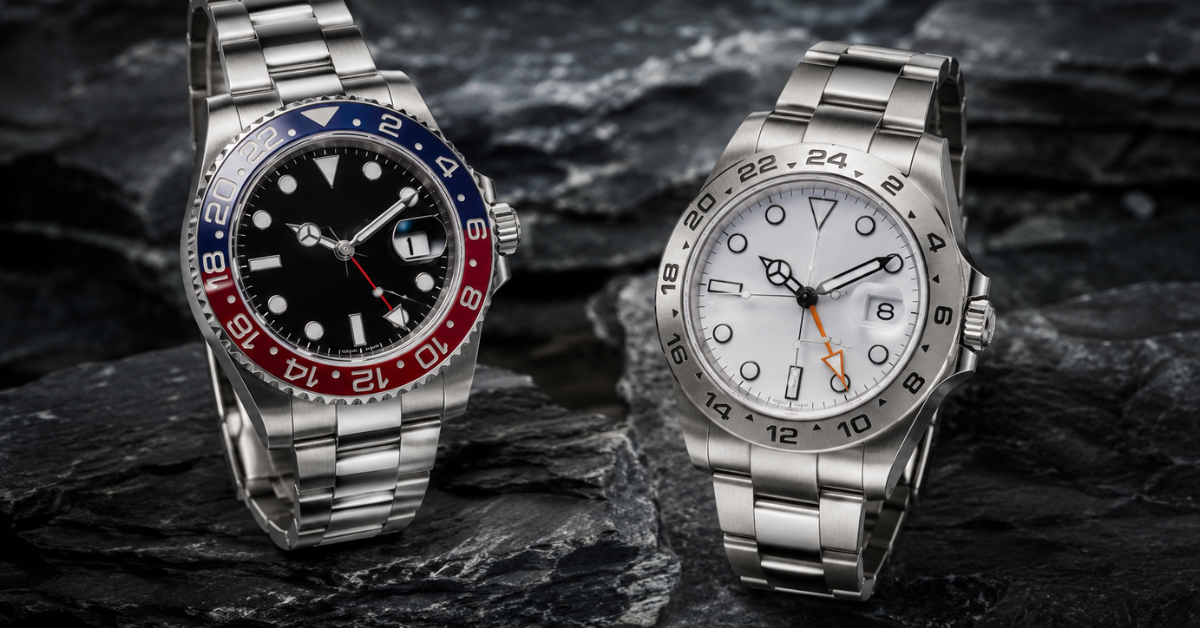
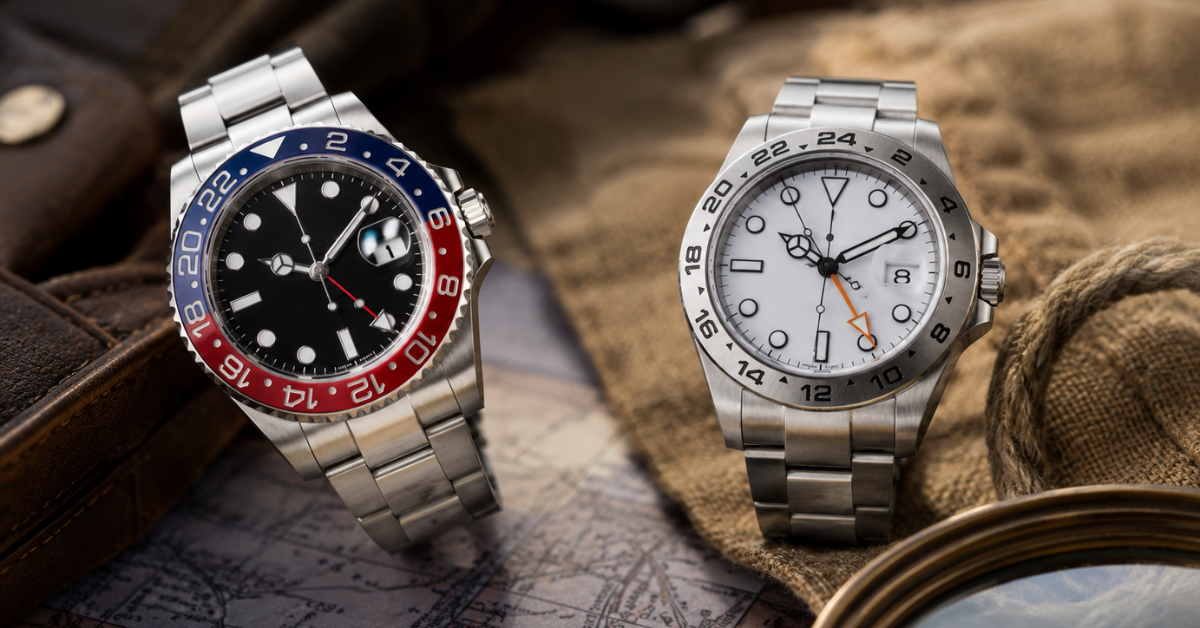
For actual travel across time zones, the GMT-Master II is the decisively better watch, and it isn't close. Its independently adjustable hour hand paired with a rotating 24-hour bezel lets you set a new local time zone in seconds while your home-time reference stays fixed on the 24-hour hand — a genuine second (or third) time zone display. The Explorer II's 24-hour hand is fixed in sync with its main hour hand and its bezel doesn't rotate, meaning it functions as an AM/PM indicator for low-light environments rather than a true second time zone tool, despite superficial dial similarities that lead many buyers to assume otherwise.
This comparison gets framed as a style debate more often than it should, because the two watches share a family resemblance — both have a fourth hand, both display 24-hour markings, both get casually referred to as "GMT" watches in listings and conversation. But one of them is built to solve a genuine travel problem and one isn't, and that distinction matters a lot more than bezel color if you're actually deciding which watch to buy for crossing time zones.
Where Each Watch Actually Comes From
The GMT-Master's original purpose was specific and practical: developed in 1954 in partnership with Pan Am, it was built for airline pilots who needed to track a second time zone at a glance while flying long-haul routes across multiple zones in a single shift. Reading two times simultaneously wasn't a nice-to-have feature — it was the entire reason the watch existed.
The Explorer II was designed for a different problem entirely: telling AM from PM in environments where natural light cues don't exist. Its intended audience — speleologists, cave explorers, and others working in extended darkness — needed a way to distinguish day from night without seeing the sun, not a way to track what time it was somewhere else in the world. That distinction in original purpose turns out to explain almost everything about how the two watches actually function today.
The Difference That Actually Matters
This is the detail that gets glossed over in a lot of comparison content, and it's the one that should genuinely decide this comparison for a travel-focused buyer.
The GMT-Master II's 24-hour hand and rotating Cerachrom bezel work together, and critically, the main hour hand can be adjusted independently in one-hour increments via the crown, without stopping the seconds hand or disturbing the 24-hour hand or minutes. In practice, that means you can land in a new time zone, quick-set the hour hand to local time in a few clicks, and still have your home time zone permanently readable on the 24-hour hand against the bezel. Combined with the rotating bezel, the watch can track up to three time zones simultaneously. That's a genuine, functional second-time-zone tool, not a marketing description.
The Explorer II's fourth hand and 24-hour markings look similar at a glance, but the mechanism underneath works differently: its 24-hour hand is fixed in sync with the main hour hand rather than independently adjustable, and its bezel is fixed rather than rotating. The result is a watch that reliably shows you whether it's roughly morning or evening — genuinely useful in a cave with no daylight — but cannot display a second time zone independent of your local time. Calling it a "GMT" watch, which happens casually in retail listings and conversation, somewhat overstates what it actually does. If you're specifically trying to understand how Rolex's family of watches actually differ in real function rather than just appearance, our Rolex Explorer guide covers the standard Explorer's own history and design philosophy, useful context for understanding the broader Explorer family's design priorities.
Case and Design
The current GMT-Master II runs a 40mm Oystersteel case (with gold and two-tone options also available), paired with a rotating Cerachrom ceramic bezel in a range of two-tone color combinations — the Batman (blue and black), Coke (red and black), and the traditional Pepsi (red and blue) among the most recognized. The bracelet includes polished center links that echo the bezel's high-luster finish, though they show minor scratches more readily than a fully brushed surface.
The Explorer II runs larger, at 42mm, with a fixed, fully brushed stainless steel bezel bearing engraved black 24-hour numerals rather than ceramic. Its bracelet is fully brushed to match, giving it a more deliberately rugged, tool-watch character than the GMT-Master II's slightly dressier polished-and-brushed mix. If you want to understand how Rolex's reference numbers encode these exact case and bezel differences, our Rolex reference numbers decoded guide walks through how to read configurations like the GMT-Master II's 126710BLNR at a glance.
Movement: Genuinely Identical Foundation
Both watches currently run Rolex's Caliber 3285, delivering a 70-hour power reserve, the antimagnetic Parachrom hairspring, the Paraflex shock protection system, and full Superlative Chronometer certification. There's no engineering gap between them here — whatever you choose, you're getting the same underlying movement quality. Our Rolex Perpetual Calibre explainer covers what that certification and movement architecture actually involve in more depth.
Pricing and Secondary Market
Current steel GMT-Master II pricing generally starts in the same broad tier as Rolex's other steel sports references, with specific hyped bezel configurations commanding real secondary-market premiums — the Batman configuration has traded in the mid-teens-of-thousands range, and less common colorways or discontinued bezel combinations have traded considerably higher still. The Explorer II, lacking the ceramic bezel and carrying less collector mythology around specific dial colors, generally trades closer to retail with less dramatic premiums attached. If you're weighing secondary-market dynamics specifically, our coverage of Submariner pricing by reference illustrates the same kind of reference-specific premium behavior that applies across Rolex's steel sports lineup, GMT-Master II included.
So, Which One Should You Actually Buy for Travel?
If the honest use case is tracking a second time zone while traveling — knowing what time it is back home while living on local time somewhere else — the GMT-Master II is simply the correct tool. It was engineered for exactly that problem in 1954 and still solves it more directly than almost any other watch in Rolex's current catalog.
The Explorer II is a genuinely excellent watch, but it's excellent at something else: rugged legibility in environments with unreliable light, built with an adventurer's toughness rather than a frequent flyer's need to juggle time zones. Buying it specifically as a travel watch means buying it for what it looks like rather than what it does — which is a fine reason to want a watch, but worth knowing clearly before you spend Rolex money assuming otherwise.
FAQ
Can the Rolex Explorer II track a second time zone like the GMT-Master II? Not independently — the Explorer II's 24-hour hand moves in sync with its main hour hand and its bezel is fixed, so it functions as an AM/PM indicator rather than a true second time zone display.
What's the main functional difference between the GMT-Master II and Explorer II? The GMT-Master II has an independently adjustable hour hand paired with a rotating 24-hour bezel, allowing genuine second and third time zone tracking, while the Explorer II lacks both features.
Is the GMT-Master II or Explorer II bigger? The Explorer II is larger at 42mm, compared to the GMT-Master II's more typical 40mm case.
Do the GMT-Master II and Explorer II use the same movement? Yes — both currently run Rolex's Caliber 3285, with a 70-hour power reserve and full Superlative Chronometer certification.
Which is the better everyday watch if I don't need GMT function? The Explorer II's rugged, fully brushed design and larger case suit buyers who want a tool-watch aesthetic without needing genuine multi-time-zone tracking, while the GMT-Master II suits buyers who want the function and the more recognized design.
Conclusion
Judged purely as a travel tool, this comparison isn't close: the GMT-Master II was built to solve the exact problem international travelers actually have, and it still does that better than its dial-mate. The Explorer II earns its place in Rolex's lineup for a genuinely different reason — legibility in darkness, not time zone tracking — and buyers chasing an actual second-time-zone watch should let the GMT-Master II's real functional edge, not just its similar-looking fourth hand, make the decision.
Senior Writer
James Whitfield
Senior watch writer with a decade covering Swiss horology, vintage markets and modern releases.