On this page
The Rolex Datejust and Oyster Perpetual share the same case construction, water resistance, and current-generation movement family, but differ in three concrete ways: the Datejust has a date window with a magnifying Cyclops lens that the Oyster Perpetual lacks entirely; the Datejust offers fluted-bezel and Jubilee-bracelet options the Oyster Perpetual doesn't; and the Datejust starts around $8,000 versus roughly $5,550 to $7,050 for the Oyster Perpetual. As of 2026, the Oyster Perpetual is also available in gold and two-tone for the first time in its history, narrowing one gap that used to separate the two collections entirely.
The Datejust and Oyster Perpetual get compared constantly, and for good reason — they're built on genuinely similar foundations, which makes the actual differences easy to either overstate or completely miss. This breaks down what's real, what's just styling, and what changed significantly in 2026.
Where They Come From
The Oyster Perpetual traces its lineage back to the original 1926 Oyster case — Rolex's first waterproof case design, and the foundation every other current Rolex model is ultimately built on. In its current form, the OP represents that foundation at its most literal: time-only display, smooth bezel, Oyster bracelet, nothing added.
The Datejust arrived later, in 1945, and it carries a genuinely significant engineering credential: it was the world's first self-winding wristwatch to display the date automatically through a window on the dial, changing instantaneously at midnight rather than gradually over several hours the way many date mechanisms of that era did. That's not a marketing claim — it's a specific, documented mechanical first, and it's part of why the Datejust has held its position as Rolex's signature model for eighty years. If you want the deeper mechanical background on how Rolex's self-winding movements work more broadly, our Rolex Perpetual Calibre explainer covers the automatic winding system both watches share.
The Real Differences
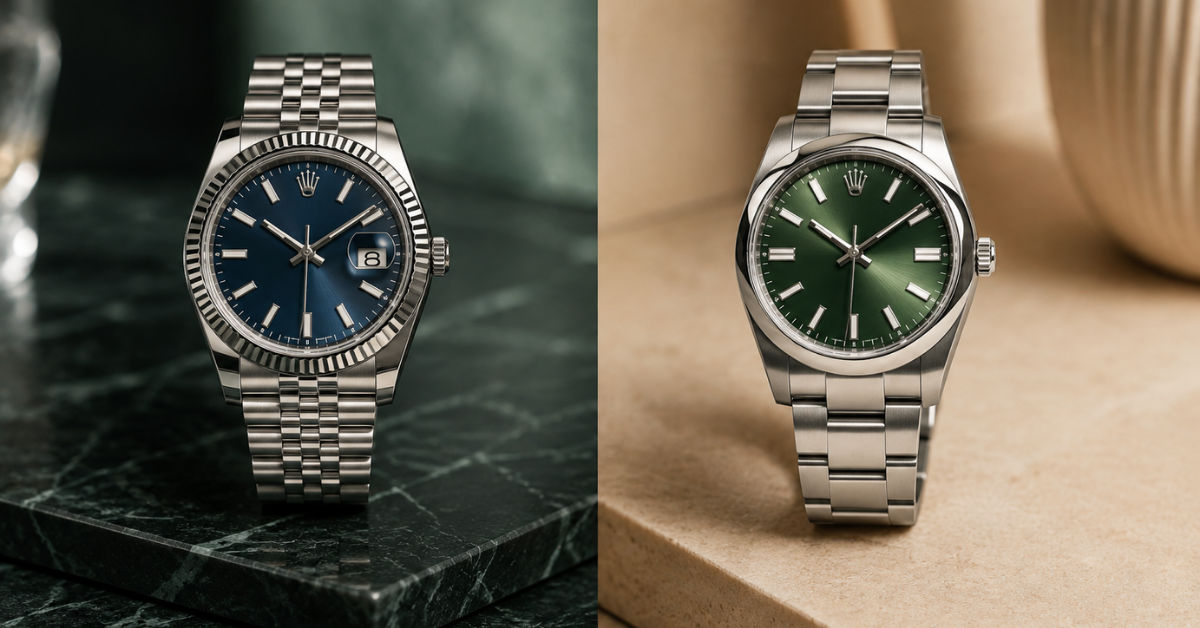
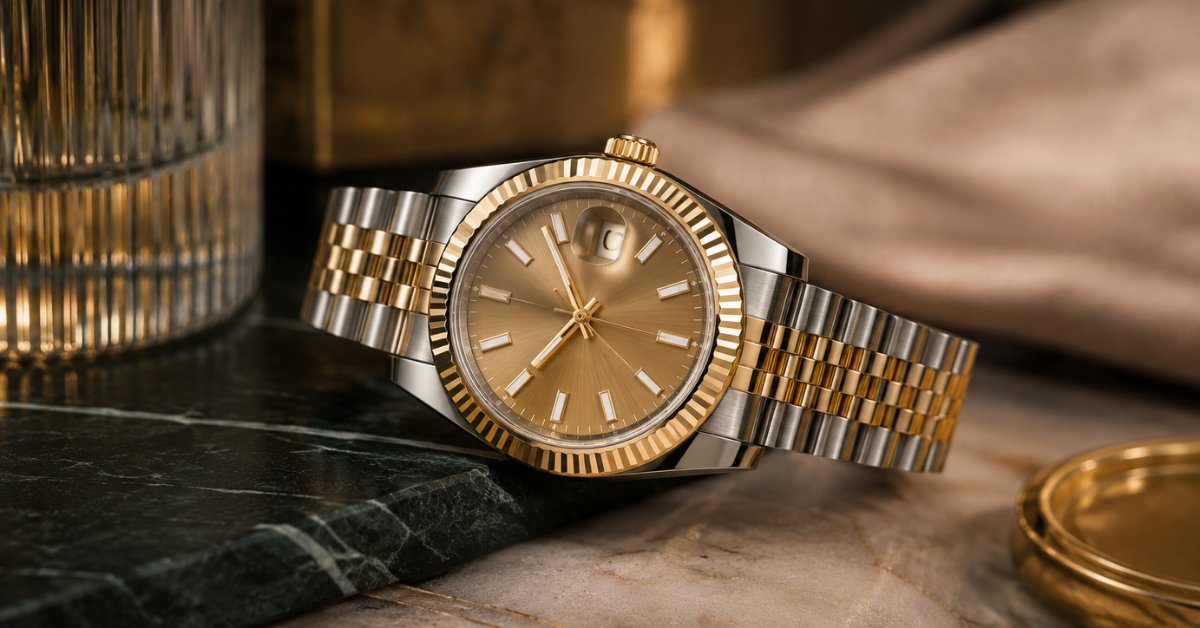
Date window and Cyclops lens. This is the most obvious distinction and the one that actually defines each watch's character. The Datejust displays the date at 3 o'clock under Rolex's signature Cyclops magnifying lens, a feature so associated with the model that it later spread to the Submariner Date and other references. The Oyster Perpetual has neither — no date window, no Cyclops, a perfectly symmetrical dial that a lot of purists specifically prefer.
Bezel options. The Oyster Perpetual comes exclusively with a smooth bezel — clean, modern, no variation across the current lineup. The Datejust offers three: smooth, fluted, and diamond-set. The fluted bezel in particular is worth understanding specifically: it's crafted only in 18-karat gold, even on an otherwise all-steel Datejust, which is why a fluted-bezel Datejust always costs more than the smooth-bezel version of the same size and material.
Bracelet options. Both watches offer the standard Oyster bracelet, but the Datejust additionally offers the five-link Jubilee bracelet — a dressier, more articulated design historically reserved for the Datejust and a few other references, and part of what gives it a more formal presence on the wrist.
Material availability — and what changed in 2026. Historically, this was one of the starkest differences between the two: the Oyster Perpetual was steel-only, while the Datejust offered extensive two-tone and precious-metal options. That changed in 2026. For the Oyster case's 100th anniversary, Rolex did something genuinely unprecedented for the OP line — introducing it in Rolesor two-tone and full 18-karat yellow gold for the first time in the collection's history. It's a significant shift in the Oyster Perpetual's positioning, and worth knowing if your understanding of the two watches is based on how they compared even a year or two ago.
What's Actually the Same
This matters as much as the differences. Both watches currently run Rolex's latest-generation calibres — the Datejust on Calibre 3235, the Oyster Perpetual on Calibre 3230 — both delivering a 70-hour power reserve and full chronometer certification. Case thickness differs by a negligible 0.2mm (11.8mm Datejust versus 11.6mm OP), both share 100 meters of water resistance, the same screw-down Twinlock crown, and scratch-resistant sapphire crystal throughout. If you're trying to understand what these reference numbers actually encode — the 126234, 124300, and similar strings that show up across both lines — our Rolex reference numbers decoded guide walks through how to read them.
The takeaway worth sitting with: the differences between these two watches are aesthetic and functional, not mechanical. Neither is the "better engineered" watch — they're built to the same standard and differ in what they're dressed in and what they display.
Pricing: A Real, Consistent Gap
Current steel pricing generally starts around $5,550 to $7,050 for the Oyster Perpetual depending on case size, against roughly $8,000 to $8,100 for the entry Datejust. Add a fluted white-gold bezel and the Datejust climbs further — approximately $1,450 more on the 36mm, $2,400 more on the 41mm. Gold and two-tone configurations on either watch push well beyond that, with full gold models on both lines running into the tens of thousands.
Secondary Market: A Counterintuitive Twist
Here's a detail that surprises a lot of buyers who assume the more expensive, more complicated watch also commands the stronger resale premium. It doesn't, necessarily. The Datejust 41 has a long, consistent track record of trading 15% to 25% above retail. The Oyster Perpetual 41, by contrast, has traded at a considerably higher percentage premium in early 2026 — reportedly around 45% above retail — driven heavily by demand for its colored dial options and the allocation scarcity around specific references like the turquoise "Tiffany blue" 41mm. If you're weighing either watch with resale in mind, our coverage on Submariner pricing by reference breaks down the same kind of premium dynamics on Rolex's sports lineup, useful context for understanding how allocation scarcity affects pricing across the brand more broadly, not just on one model.
Which One Should You Actually Buy
- Want the most versatile, dressiest Rolex with the most customization? Datejust — the fluted bezel and Jubilee bracelet options genuinely widen what the watch can do across formal and casual settings.
- Want the purest, most minimalist Rolex at the lowest entry price? Oyster Perpetual — no date window competing with the dial's symmetry, and a real price advantage.
- Want a two-tone or gold Rolex without a date complication? Only possible as of 2026, and only on the Oyster Perpetual — a genuinely new option that didn't exist before this year.
- Care primarily about resale premium? Check current data for the specific reference and size you're considering rather than assuming the pricier watch automatically wins — the 2026 numbers say otherwise for the 41mm OP specifically.
Servicing Either Watch
Both watches sit in the same, most affordable service tier at official Rolex Service Centers, generally around $800 for a complete overhaul, reflecting their similarly simple three-hand-or-three-hand-plus-date movement construction. Our Rolex servicing costs guide covers what that service actually includes and how to budget for it regardless of which watch you choose.
FAQ
What's the main difference between a Rolex Datejust and Oyster Perpetual? The Datejust has a date window with a Cyclops magnifying lens and offers fluted-bezel and Jubilee-bracelet options; the Oyster Perpetual has neither, running a purely time-only display with a smooth bezel only.
Is the Datejust or Oyster Perpetual more expensive? The Datejust starts higher, generally around $8,000, versus roughly $5,550 to $7,050 for the Oyster Perpetual depending on case size.
Can you get a gold Oyster Perpetual? As of 2026, yes — for the first time in the collection's history, Rolex introduced the Oyster Perpetual in Rolesor two-tone and full 18-karat gold, alongside the traditional steel-only lineup.
Which holds its value better, the Datejust or Oyster Perpetual? It varies by reference and size — the Datejust 41 has a longer track record of trading 15% to 25% above retail, while the Oyster Perpetual 41 has traded at a reportedly higher premium, around 45%, in early 2026, driven by colored dial demand.
Do the Datejust and Oyster Perpetual use the same movement? They use closely related current-generation calibres — Datejust on Calibre 3235, Oyster Perpetual on Calibre 3230 — both with 70-hour power reserves and full chronometer certification.
Conclusion
The Datejust and Oyster Perpetual aren't really a "better versus worse" comparison — they're built to the same mechanical standard and differ in exactly the ways their names suggest: one adds a date and options, the other stays deliberately essential. The gap that used to separate them most clearly, material availability, narrowed significantly in 2026 with the OP's first-ever gold and two-tone models. What's left is a genuine style and price decision, not a quality one.
Senior Writer
James Whitfield
Senior watch writer with a decade covering Swiss horology, vintage markets and modern releases.