On this page
- Rolex Doesn't Invent New Gold Very Often
- What Is Rolex Jubilee Gold?
- Rolex's Gold Family, Explained
- Why Launch It on the Day-Date?
- The Day-Date 40 in Jubilee Gold (Ref. 228235JG)
- The Dial
- The Case and Bracelet
- The Movement
- How Much Does a Jubilee Gold Day-Date Cost?
- Can You Actually Buy One?
- Will Jubilee Gold Come to Other Rolex Models?
- Is Jubilee Gold Worth It?
- What Else Rolex Launched This Year
- Frequently Asked Questions
- What is Rolex Jubilee Gold?
- Which Rolex watches come in Jubilee Gold?
- How much is the Rolex Jubilee Gold Day-Date?
- When did Rolex last introduce a new gold alloy?
- What's the difference between Jubilee Gold and Everose?
- Is the Jubilee Gold Day-Date a limited edition?
- The Bottom Line
Rolex Doesn't Invent New Gold Very Often
Most watch brands buy their gold. Rolex makes its own. It runs its own foundry, casting the precious metals that go into every gold case and bracelet. That gives it something few brands have: the ability to create alloys no one else can use.
Even so, Rolex rarely adds a new one. The last time was 2005, when it introduced Everose, its pink gold. Two decades later, at Watches and Wonders 2026, it finally did it again with Rolex Jubilee Gold.
And in true Rolex style, the new metal didn't arrive across the catalogue. It arrived on exactly one family: the Day-Date, the watch everyone calls the President. Here's what Jubilee Gold is, why Rolex chose the Day-Date to launch it and whether it's worth the price.
What Is Rolex Jubilee Gold?
Jubilee Gold is an 18-carat gold alloy, meaning it's 75% pure gold mixed with other metals that give it its colour, hardness and durability. Rolex designed, developed and produces it in-house.
What makes it different is the colour. Instead of the bright warmth of yellow gold or the clear pink of Everose, Jubilee Gold sits somewhere in between. Rolex describes it with tones of tender yellow, warm grey and soft pink. In person, reviewers call it muted and subtle, a gold that glows rather than shines.
Rolex hasn't published the exact recipe, and it's unlikely to. Its alloys are closely guarded, and the mix of metals is what gives each one its unique tone. Rolex also hasn't explained the name, though many collectors link it to the celebrations surrounding this year's launch.
Rolex's Gold Family, Explained
Jubilee Gold now joins Rolex's other precious metals. Here's how they compare:
- 18k yellow gold: the classic warm, bright gold of the original President
- 18k white gold: cool and silvery, often mistaken for steel from a distance
- 18k Everose gold: Rolex's pink gold, introduced in 2005 and formulated to resist fading over time
- 950 platinum: the heaviest and most exclusive metal Rolex uses, with its own signature ice blue dial
- 18k Jubilee Gold (new for 2026): a soft, muted blend of yellow, grey and pink tones
Rolex also uses mixed-metal combinations like Rolesor (steel and gold). If you're curious how Rolex approaches its other signature metal, see how Oystersteel differs from regular stainless steel.
Why Launch It on the Day-Date?
The choice makes perfect sense once you know the Day-Date.
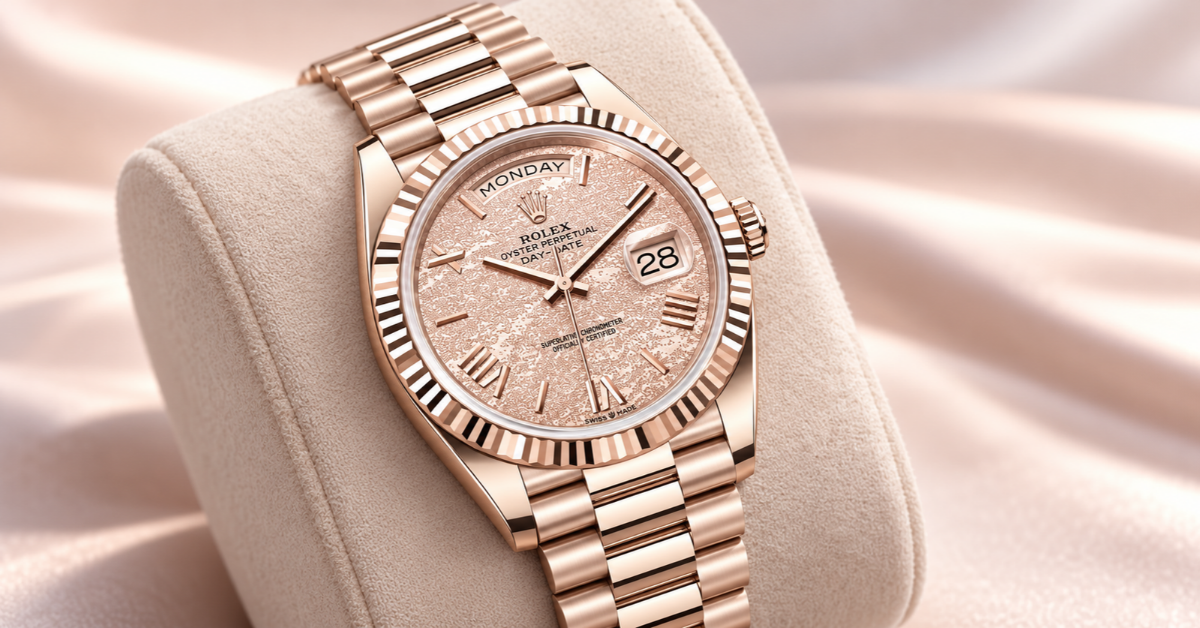
The Day-Date has been made only in precious metals for decades. It's Rolex's flagship gold watch, the one that's been on presidents' wrists since the 1960s. If Rolex was going to show off a brand-new gold, there was only one watch that could carry it properly.
The timing mattered too. 2026 marks 100 years since Rolex patented the Oyster case in 1926, the world's first waterproof wristwatch case, and the 70th anniversary of the Day-Date itself, launched in 1956. A new gold for the President in that year was a statement. For the full story of the Day-Date, read our complete Rolex President buying guide.
The Day-Date 40 in Jubilee Gold (Ref. 228235JG)
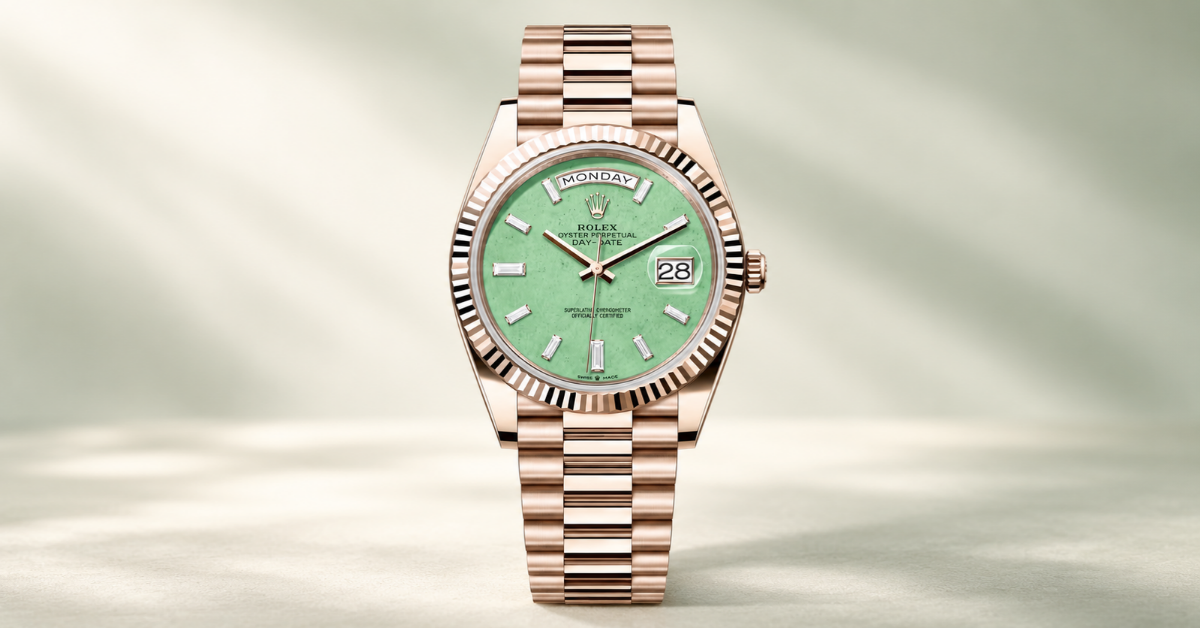
The first, and so far only, catalogued watch in Jubilee Gold is the Day-Date 40 ref. 228235JG. Rolex placed it in its "Exceptional Watches" category alongside the Rolesium Daytona, a signal that this is a showcase piece rather than an everyday catalogue model.
The Dial
Rolex paired the new gold with a natural light green aventurine stone dial. Aventurine has tiny glittering inclusions, so the dial sparkles gently as it catches the light, and because it's natural stone, no two dials are exactly the same.
The hour markers are ten baguette-cut diamonds, and the hands are made of Jubilee Gold too. The day of the week is spelled out at 12 o'clock in a Jubilee Gold frame, with the date under a Cyclops lens at 3 o'clock.
The Case and Bracelet
Everything you'd expect from a Day-Date 40 is here: the 40mm Oyster case, the fluted bezel and the President bracelet, all made in Jubilee Gold. Water resistance is 100m.
The Movement
Inside is the calibre 3255, the same movement as other modern Day-Date 40s. It uses Rolex's Chronergy escapement and blue Parachrom hairspring for efficiency and resistance to magnetism and temperature changes, with about 70 hours of power reserve.
A second Jubilee Gold Day-Date 40, with a gold leaf motif dial and Roman numerals, has also been reported as an off-catalogue piece. Off-catalogue Rolexes are typically offered only to selected clients through boutiques.
How Much Does a Jubilee Gold Day-Date Cost?
The Day-Date 40 ref. 228235JG launched at $62,700. After Rolex's gold price increase on June 1, 2026, its US retail price rose to $65,700, before taxes.
For context, here's how it compares with other Day-Date 40s:
- Day-Date 40 in yellow gold: from about $48,000
- Day-Date 40 in Jubilee Gold (228235JG): $65,700
- Day-Date 40 in platinum: from about $68,800
Part of that premium is the new metal, but much of it is the aventurine dial and the diamonds. A plain Jubilee Gold Day-Date would likely cost less, if Rolex ever makes one.
Rolex's gold watches have been hit especially hard by recent price rises as gold itself has climbed. For background, see what collectors think of Rolex's price increases.
Can You Actually Buy One?
In theory, yes. It's sold through Rolex boutiques and authorised retailers. In practice, it's one of the hardest Rolexes to get.
New alloys are produced in small quantities at first, and showcase pieces like this tend to go to a retailer's most established clients. Expect strong demand, limited availability and secondary market prices above retail in the early years. If you're hoping to buy one at retail, read whether the Rolex waiting list is still a thing to understand how allocation really works.
Will Jubilee Gold Come to Other Rolex Models?
Almost certainly, eventually. When Rolex launched Everose in 2005, it spread across many collections over the following years. Several reviewers expect Jubilee Gold to follow a similar path as the foundry ramps up production.
But Rolex hasn't announced anything, and it moves slowly. For now, the Day-Date owns Jubilee Gold, and that exclusivity is a big part of its appeal.
Is Jubilee Gold Worth It?
For collectors, yes. Owning the first watch in Rolex's first new gold alloy in two decades is a genuine piece of Rolex history, and early examples of new materials often become sought after.
For buyers who just want a gold Day-Date, maybe not. A yellow gold or Everose Day-Date 40 gives you the same watch, the same movement and the same presence for thousands less. The Jubilee Gold version is about the subtle colour, the stone dial and the story.
If you do go for it, buy only through Rolex retailers or trusted dealers. A rare new model is exactly what counterfeiters target, so read 7 signs your Rolex might be a fake before buying on the secondary market.
What Else Rolex Launched This Year
Jubilee Gold was just one headline from a big year for Rolex. The brand also refreshed the Datejust's Roman numerals, which we cover in the Datejust's new Roman numeral dial, explained. And for a glimpse of what Rolex's most exclusive pieces can command, see how four one-off Daytonas sold for $49.4 million.
Frequently Asked Questions
What is Rolex Jubilee Gold?
Rolex Jubilee Gold is a new proprietary 18-carat gold alloy developed and produced in Rolex's own foundry. Introduced at Watches and Wonders 2026, it has a soft, muted colour combining tones of yellow, warm grey and pink.
Which Rolex watches come in Jubilee Gold?
As of 2026, Jubilee Gold is used only on the Rolex Day-Date 40, ref. 228235JG, with a light green aventurine dial and ten baguette diamond hour markers. A second off-catalogue version with a gold leaf motif dial has also been reported.
How much is the Rolex Jubilee Gold Day-Date?
The Rolex Day-Date 40 in Jubilee Gold, ref. 228235JG, launched at $62,700 and rose to $65,700 in the US after Rolex's June 2026 gold price increase.
When did Rolex last introduce a new gold alloy?
Before Jubilee Gold, Rolex's last new gold alloy was Everose, its proprietary pink gold, introduced in 2005.
What's the difference between Jubilee Gold and Everose?
Everose is Rolex's pink gold, with a clear rosy tone designed to resist fading. Jubilee Gold is more muted, blending yellow, grey and pink tones for a softer, subtler look.
Is the Jubilee Gold Day-Date a limited edition?
No. It isn't a numbered limited edition, but it's produced in small quantities and listed in Rolex's "Exceptional Watches" category, so it's very hard to find at retail.
The Bottom Line
Rolex waited twenty years to make a new gold, and then gave it to just one watch. That tells you how seriously it takes Jubilee Gold, and how special the Day-Date is to the brand.
Whether you buy one or simply admire it, the Jubilee Gold Day-Date marks a rare moment: Rolex quietly adding a new colour to the most famous gold watch in the world.
Senior Writer
James Whitfield
Senior watch writer with a decade covering Swiss horology, vintage markets and modern releases.