On this page
- Where Each One Actually Comes From
- The Surprising Truth About the Air-King's "Aviation" Dial
- Current Specs: Genuinely Identical Engineering
- Design Philosophy: Quiet Versatility vs. Bold Character
- Pricing: Close Enough That the Comparison Actually Matters
- Availability and Resale
- So, Which One Should You Actually Buy?
- Servicing Either Watch
- FAQ
- Conclusion
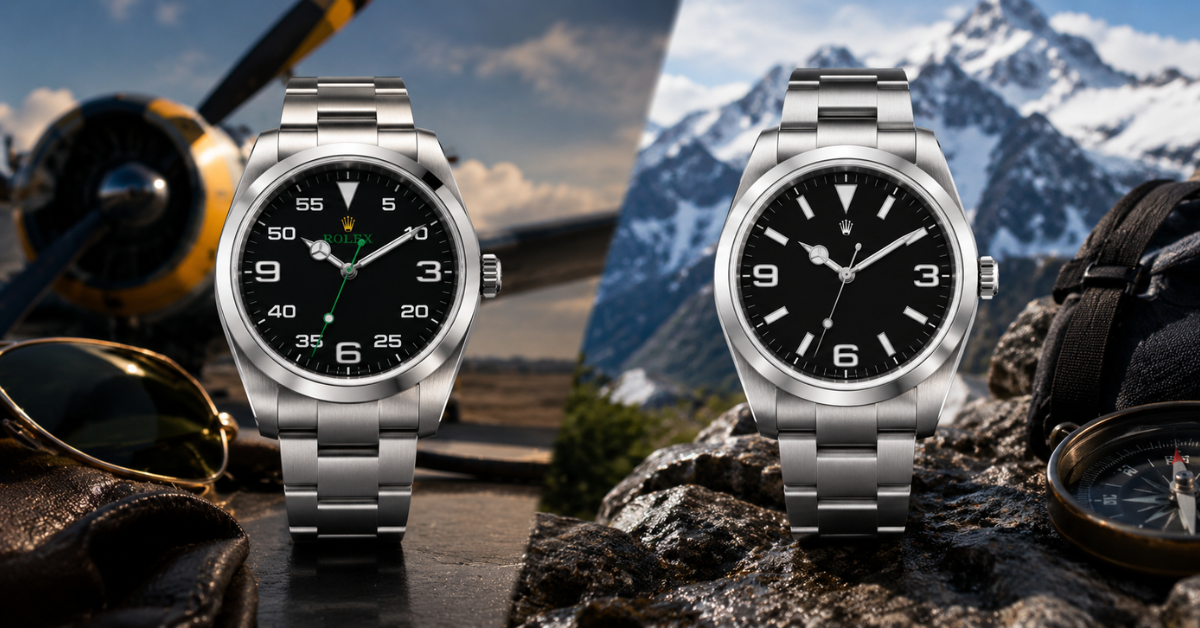
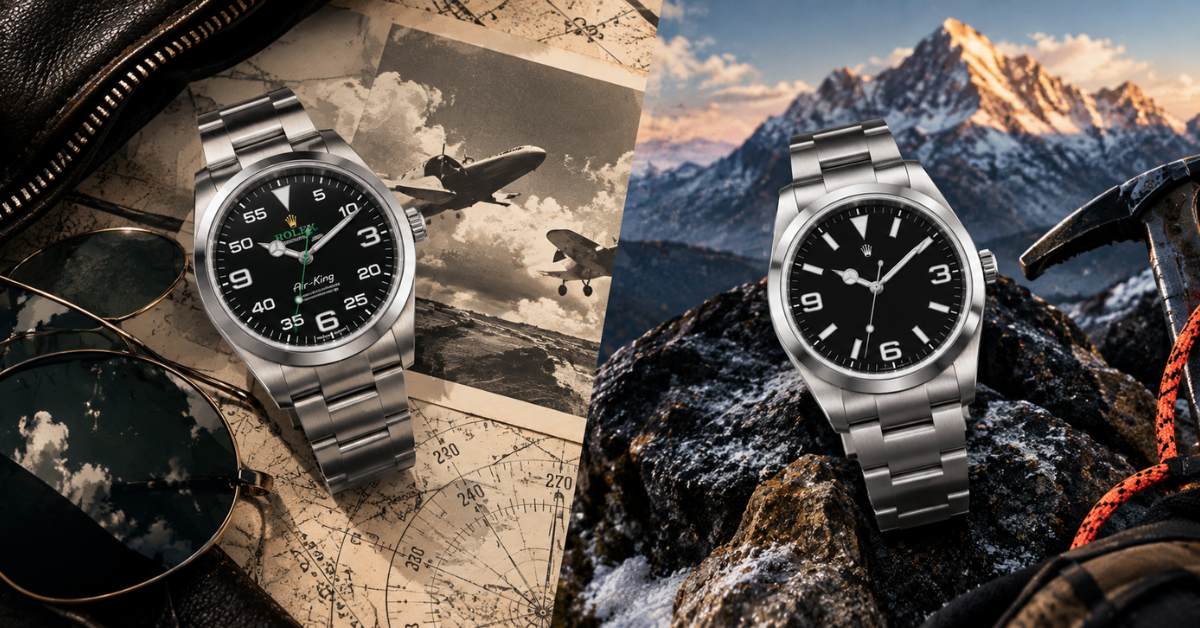
There's no actual restriction on comparing the Rolex Air-King and Explorer — but the two rarely get discussed side by side because they occupy genuinely overlapping territory: identical Caliber 3230 movements, nearly identical retail pricing (roughly $8,150 for the Air-King versus $7,900 to $8,350 for the Explorer), and the same "entry professional" positioning in Rolex's catalog. The real difference is design philosophy—the Explorer offers clean, understated versatility in 36mm or 40mm, while the Air-King commits to a bold, distinctive 40mm-only design with a dial history that has nothing to do with aviation, despite its name.
Worth clearing up immediately: Rolex hasn't banned this comparison, and no dealer is under instruction to steer buyers away from it. What's genuinely true is that these two watches compete for close to the identical buyer — same movement, same rough price, same simple three-hand layout — which means putting them directly side by side risks making one look like it's cannibalizing the other's sales pitch. That's likely part of why you won't find Rolex's own marketing encouraging the comparison. This does it properly.
Where Each One Actually Comes From
The Explorer's 1953 origin is well documented — built as Rolex's tribute to the British expedition that first summited Everest that year, tested against the extreme cold the climb involved. Our full Explorer history covers that story and the watch's design philosophy in depth.
The Air-King's history runs even further back, to 1945, when Hans Wilsdorf created an entire "Air" series — Air-Lion, Air-Giant, Air-Tiger, and Air-King — specifically to honor British Royal Air Force pilots who'd worn privately purchased Rolex Oysters on combat missions during World War II. Only the Air-King name survived long-term, earning its own standalone collection by 1958, a position it's held ever since with just one brief interruption.
The Surprising Truth About the Air-King's "Aviation" Dial
This is genuinely worth knowing before assuming the Air-King's dial design has a straightforward aviation pedigree matching its name — it doesn't, and the actual story is more interesting. The current Air-King's distinctive dial layout, with its bold color accents and busier arrangement, was inspired by the dashboard instrumentation Rolex designed for the Bloodhound SSC, later Bloodhound LSR — a British supersonic land-speed-record car project, not an aircraft. It's an aviation-named watch wearing a motorsport-inspired dial, a detail that surprises even people who own one.
There's a genuine historical twist worth adding here too: the original 1950s Air-King reference 5500 actually borrowed its 3-6-9 dial layout from the Explorer's own design, not the other way around. The resemblance between these two watches has real, documented roots stretching back over seventy years, even though the current-generation watches have since diverged into genuinely different visual identities.
Current Specs: Genuinely Identical Engineering
This is where the comparison gets interesting rather than obvious. Both the current Air-King (126900) and Explorer (124270/224270) run the exact same Caliber 3230 — 70-hour power reserve, the Chronergy escapement, and the Parachrom hairspring for antimagnetic resistance. There's no engineering gap here at all; choosing between them tells you nothing about movement quality, only about size and design preference. Our Rolex Perpetual Calibre explainer covers what that shared movement platform actually involves.
Where they genuinely diverge is size flexibility. The Air-King comes in a fixed 40mm case only. The Explorer offers both 36mm and 40mm, giving it real range across different wrist sizes that the Air-King simply doesn't match. Both share Rolex's 904L Oystersteel construction and the current Oysterlock Easylink bracelet clasp, but reviewers consistently note the Air-King wears noticeably bolder on the wrist than its diameter alone suggests, largely due to its thickness and crown guards — a design element borrowed from the modern GMT-Master II case family in the 2022 update.
Design Philosophy: Quiet Versatility vs. Bold Character
This is really the entire decision, once you strip away the shared movement. The Explorer is consistently described by collectors as one of the most versatile watches Rolex makes — a clean, understated dial that moves from outdoor settings to business meetings without drawing unnecessary attention. The Air-King goes the opposite direction entirely: green seconds hand, yellow crown logo, a genuinely busier dial arrangement, built for buyers who want character and a distinctive look over conservative restraint.
Neither approach is more "correct." It's a genuine style fork within watches that share identical internals.
Pricing: Close Enough That the Comparison Actually Matters
Current retail pricing puts these two watches within a few hundred dollars of each other — the Air-King around $8,150, the Explorer generally $7,900 for the 36mm and $8,350 for the 40mm. That overlap is precisely why this comparison is worth making seriously rather than treating one as the obvious budget pick: at this price proximity, the decision genuinely comes down to design preference and size fit, not value.
Availability and Resale
Worth being honest about a real distinction here: the Explorer's iconic status and broader collector recognition have historically made it somewhat harder to secure at an authorized dealer than the Air-King, even though both remain considerably more accessible than Rolex's most hyped sports references like the Submariner or Daytona. That same iconic status has also translated to generally stronger secondary-market performance for the Explorer over time, though the Air-King has built a solid, genuinely sought-after following of its own among buyers who specifically want its distinctive look. If you want the fuller picture on how Rolex allocation currently works across the catalog, our Rolex waitlists in 2026 coverage breaks that down in more depth.
So, Which One Should You Actually Buy?
- Want the widest size flexibility and the most broadly versatile design? The Explorer, especially if you're choosing between 36mm and 40mm to match your specific wrist.
- Want a bolder, more distinctive watch that stands apart from Rolex's more conservative options? The Air-King delivers that without sacrificing anything on the movement side.
- Care primarily about long-term resale strength? The Explorer has the stronger historical track record, though the Air-King isn't far behind.
- Just want the better deal between two watches that are mechanically identical anyway? At this price proximity, that calculation mostly resolves to which one you'd actually enjoy wearing more.
Servicing Either Watch
Both watches sit in Rolex's most accessible service tier, thanks to their shared, relatively simple movement architecture. Our Rolex servicing costs guide covers what to expect for either watch, useful for budgeting regardless of which one you choose.
FAQ
Do the Rolex Air-King and Explorer use the same movement? Yes — both the current Air-King (126900) and Explorer (124270/224270) run the identical Caliber 3230, with a 70-hour power reserve and the same Chronergy escapement and Parachrom hairspring.
Is the Air-King's dial actually inspired by aviation? Not directly — despite its aviation-themed name and history, the current Air-King's dial design was inspired by the dashboard of the Bloodhound SSC, a British supersonic land-speed-record car project, not an aircraft.
What sizes does each watch come in? The Air-King is available only in a fixed 40mm case, while the Explorer offers both 36mm and 40mm options.
Which is harder to get at an authorized dealer, the Air-King or Explorer? The Explorer is generally somewhat harder to secure due to its stronger collector recognition, though both remain considerably more attainable than Rolex's most hyped sports references.
Is the Air-King or Explorer a better long-term investment? The Explorer has historically shown stronger secondary-market performance thanks to its iconic status, though the Air-King has built a genuinely solid following of its own.
Conclusion
Once you know both watches share identical engineering, the Air-King versus Explorer decision stops being about which is "better" and becomes a genuine question of taste and fit — the Explorer's quiet, size-flexible versatility against the Air-King's bold, motorsport-inspired distinctiveness wearing an aviation name. Neither watch loses this comparison mechanically. It just comes down to which character you actually want on your wrist.
Senior Writer
James Whitfield
Senior watch writer with a decade covering Swiss horology, vintage markets and modern releases.