On this page
Yes, and the case is stronger than the watch's design alone suggests. The Rolex Land-Dweller, unveiled at Watches & Wonders 2025, houses the Caliber 7135—Rolex's first genuinely new escapement architecture in decades, called Dynapulse, alongside the brand's first high-frequency movement at 5 Hz. It's the subject of 16 patents, delivers a 66-hour power reserve despite the higher beat rate, and sits in a case just 9.7mm thick with a rare sapphire exhibition caseback. Specialist watch publications have called it the most discussed debut of the show and a genuinely game-changing release, not an incremental update. Retail starts around $14,450, though secondary-market pricing has already reached two to three times that.
Rolex doesn't reinvent its own engineering often, and when it does, the watch world tends to notice. The Land-Dweller is exactly that kind of release — not because of how it looks, though the design is a real departure too, but because of what's actually inside it. This covers why specialists are calling it one of Rolex's most significant releases in years, and what that actually means in practice.
The Third "Dweller"
Unveiled at Watches & Wonders 2025, the Land-Dweller joins the Sea-Dweller and Sky-Dweller as the third pillar in Rolex's "Dweller" naming, but its purpose differs from both. Where the Sea-Dweller was built for saturation diving and the Sky-Dweller for crossing time zones, our Sky-Dweller review covers that watch's own case for existing — the Land-Dweller was designed specifically for everyday life on solid ground, drawing a direct design line back to the cult-classic 1970s Oysterquartz rather than any dive or travel tool in Rolex's history.
The Real Story: Caliber 7135 and the Dynapulse Escapement
This is where the watch actually earns its significance, and it's worth explaining properly rather than treating it as a spec-sheet bullet point. The Caliber 7135 is built around an entirely new escapement architecture Rolex calls Dynapulse — the brand's first genuinely new escapement design in decades, not an evolution of the existing Chronergy escapement used across the rest of the current lineup. Technically, it's best described as an indirect-impulse, double-wheel escapement built entirely in silicon, where energy from twin escape wheels transfers to the balance wheel through a silicon lever rather than directly. That places it conceptually close to a "natural escapement" — a design pioneered by the legendary watchmaker George Daniels and produced only in tiny volumes by a handful of independent brands like F.P. Journe and Laurent Ferrier, precisely because natural escapements are notoriously difficult to manufacture reliably at any real scale.
Rolex achieving this at genuine production volume, rather than as a limited boutique exercise, is the actual headline. The Caliber 7135 is the subject of 16 patents, and it introduces Rolex's first high-frequency movement — running at 5 Hz, or 36,000 vibrations per hour, compared to the 4 Hz, 28,800-vibration standard used across virtually every other current Rolex caliber, including the Chronergy-equipped movements covered in our Rolex Perpetual Calibre explainer. Higher frequency typically drains power reserve faster, but the Dynapulse escapement's reduced friction and energy loss let the 7135 still deliver a 66-hour power reserve despite the increased beat rate — a genuine engineering achievement, not a trade-off Rolex simply accepted.
The movement also incorporates a paramagnetic silicon hairspring, a skeletonized gold rotor, and specifically optimized gear train geometry, all built around getting the most out of that new escapement design.
A Rare Window Into the Movement
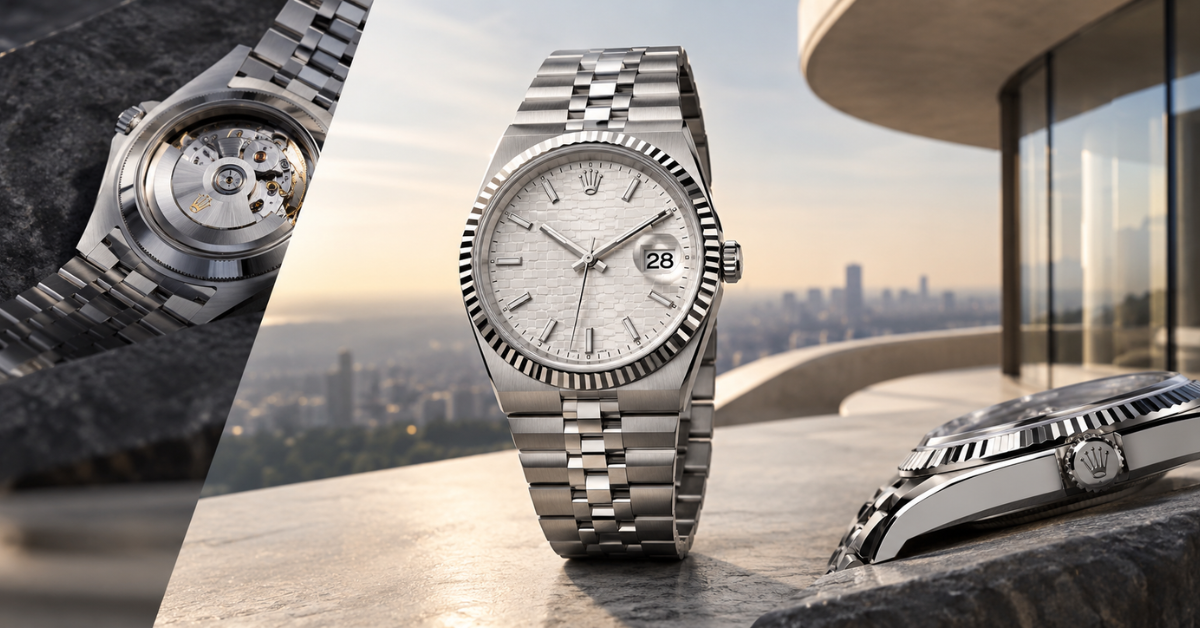
Worth flagging specifically, since we've noted the same rarity on Rolex's other recent dress-adjacent release: the Land-Dweller carries a sapphire exhibition caseback, letting owners actually see the Caliber 7135 at work. That's genuinely uncommon for Rolex, which keeps solid casebacks standard across most of its current sports catalog even on considerably more expensive references. Our Rolex 1908 review covers the only other recent Rolex release sharing this same rare transparency, suggesting a genuine, deliberate shift in how willing Rolex now is to show off its own engineering rather than keep it hidden.
Case and Design
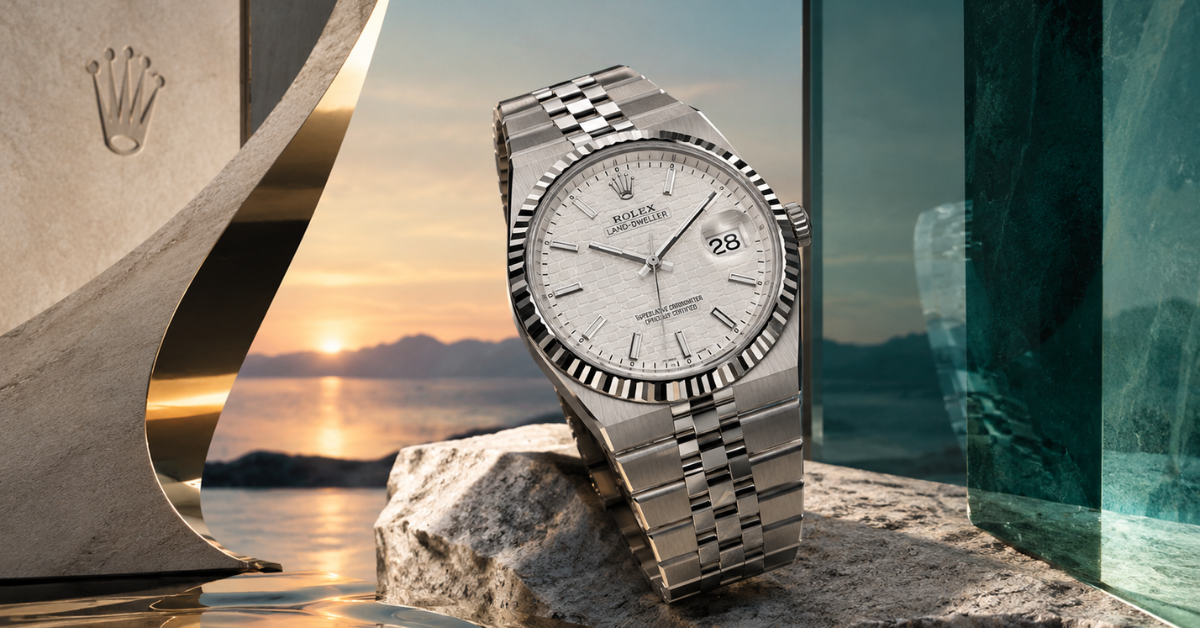
The Land-Dweller's case runs just 9.7mm thick — the slimmest Oyster Perpetual currently in Rolex's catalog, a genuine feat given the movement inside runs at a higher frequency than anything else the brand produces. The design itself draws directly on the Oysterquartz's angular, tonneau-shaped case and integrated bracelet, finished with a fluted bezel and a distinctive honeycomb-pattern dial, paired with a flat-link Jubilee bracelet that flows directly from the case rather than attaching via conventional lugs. It retains full Oyster case construction underneath that design language, carrying 100 meters of water resistance.
The Lineup
Ten references launched at once, spanning two case sizes — 36mm and 40mm — across three materials: White Rolesor (Oystersteel paired with an 18-karat white gold fluted bezel), full 18-karat Everose gold, and 950 platinum.
Pricing: Retail vs. What It's Actually Trading For
Retail pricing starts around $13,900 to $14,450 for the 36mm White Rolesor and $14,900 to $15,350 for the 40mm, with Everose gold climbing to roughly $42,100 to $46,100 and platinum reaching $59,200 to $63,500 depending on case size.
The secondary market tells a considerably more dramatic story. The 40mm White Rolesor, reference 127334, has been reported trading between $30,000 and $36,000 against its roughly $16,250 retail price — nearly double to more than double, a premium among the most extreme currently seen anywhere in Rolex's catalog. The 36mm Rolesor trades somewhat closer to earth at $24,000 to $28,000, still a substantial multiple of retail. Our coverage of Rolex waitlists in 2026 covers how allocation generally works across the current catalog — the Land-Dweller sits firmly among the references where that allocation friction runs deepest.
So, Is It Rolex's Most Important New Watch?
The honest answer is yes, and it's worth being specific about why rather than just repeating the claim. Rolex is conventionally associated with careful, incremental refinement rather than genuine architectural reinvention — the Chronergy escapement, for instance, improved on the traditional Swiss lever design rather than replacing its fundamental concept. The Dynapulse escapement is a different kind of achievement entirely: a wholly new escapement architecture, historically the domain of a handful of independent watchmakers working in tiny volumes, brought to genuine production scale for the first time. That's the kind of engineering leap the industry sees perhaps once in a generation, and specialist publications that cover Rolex closely have described the Land-Dweller in exactly those terms.
Worth being equally honest about the caveats: extreme secondary-market pricing currently makes it impractical for most buyers to acquire anywhere near retail, and as a genuinely new movement architecture, it hasn't yet accumulated the decades of proven reliability that Rolex's more established calibers carry. Historical significance and practical accessibility are two different questions, and the Land-Dweller currently answers one far more clearly than the other.
FAQ
What makes the Rolex Land-Dweller's movement so significant? Its Caliber 7135 introduces the Dynapulse escapement, Rolex's first genuinely new escapement architecture in decades, conceptually related to the rare "natural escapement" design historically limited to tiny production volumes at a handful of independent brands.
How is the Land-Dweller different from the Sea-Dweller and Sky-Dweller? Where those two watches were built for diving and travel respectively, the Land-Dweller was designed for everyday life, drawing its design language from the 1970s Oysterquartz rather than any dive or travel tool.
How much does a Rolex Land-Dweller cost? Retail starts around $13,900 to $14,450 for the 36mm steel and white gold model, climbing to $59,200 and beyond for platinum, though secondary-market prices on the popular 40mm steel reference have reached $30,000 to $36,000.
Does the Land-Dweller have a visible movement? Yes — it carries a sapphire exhibition caseback, a genuinely rare feature for Rolex, letting owners see the Caliber 7135 and its Dynapulse escapement in action.
Is the Land-Dweller easy to buy at retail? No — like many newly launched, highly discussed Rolex references, availability is extremely limited, and current secondary-market pricing reflects that scarcity clearly.
Conclusion
The Land-Dweller's real significance has nothing to do with its honeycomb dial or its Oysterquartz-inspired case, striking as both are — it's the Dynapulse escapement inside, a genuinely new mechanical architecture Rolex has managed to produce at real scale where independent watchmakers have historically only managed a handful at a time. That's a rarer kind of achievement than a new case shape, and it's exactly why specialists are treating this release as more than just another addition to the catalog.
Reviews Editor
Sofia Marchetti
Reviews editor focused on dive watches, chronographs and everyday wearability.